
Taiwanese AI server supplier Wiwynn built immersion-cooling tanks and delivered samples for customers to test, only to tear down half a factory it had built in Malaysia. Chair Emily Hong says the turning point came when NVIDIA chose a different approach to liquid cooling and the industry followed. The investment exposes a concrete problem: a supplier can develop a technology early without being able to determine which system customers ultimately adopt.
Hong even took independent directors to see what she called the “corpse.” With Wistron Chairman Simon Lin alongside her, she lamented the loss of such a promising technology. For a company that had seized the opportunities created by cloud computing and AI, the scene revealed a less discussed side of investing early: it is possible to anticipate where demand is headed and still back the wrong technology to serve it.
Getting Liquid Cooling Right Also Means Choosing the Right System
Immersion cooling submerges electronic equipment in a nonconductive coolant that carries heat away directly. Cold-plate liquid cooling instead circulates fluid through metal plates placed close to the chips, then carries the heat away through pipes. Both use liquid to remove heat, but they require different equipment layouts and maintenance procedures. The choice affects how servers are designed, installed in a data center, and serviced afterward.
Wiwynn’s commitment to immersion cooling went beyond a concept demonstration. In 2021, it announced an investment in LiquidStack and a strategic partnership in two-phase immersion cooling. The goals included bringing solutions to market faster and expanding deployment and supply-chain capabilities. Hong, then CEO, said she saw broad potential for the technology’s adoption in data centers. That announcement records Wiwynn’s technological direction at the time; her account of dismantling the factory shows the risk that early investment may fail to become the business a supplier expects.
NVIDIA’s GB200 offers a concrete comparison. Its compute-tray design incorporates cold plates and liquid-cooling connections, forming a system together with racks, switches, and high-speed interconnects. Cooling equipment must work with the entire platform to become part of a customer’s deployment.
This means that asking which technology can remove more heat addresses only part of the problem. For customers preparing to buy a complete AI system, the other questions are whether equipment will fit the specified rack, how cooling pipes will be arranged, and how on-site staff will install and maintain it. Even a working solution still has to clear the hurdle of system adoption.
How Platform Specifications Steer Supplier Investment
In 2024, NVIDIA contributed liquid-cooling designs for the GB200 NVL72’s rack, compute trays, and switch trays to the Open Compute Project (OCP). The published designs cover liquid-cooling manifolds, blind-mate connections, rails (slides), and rack modifications, allowing partners to develop products around a common design.
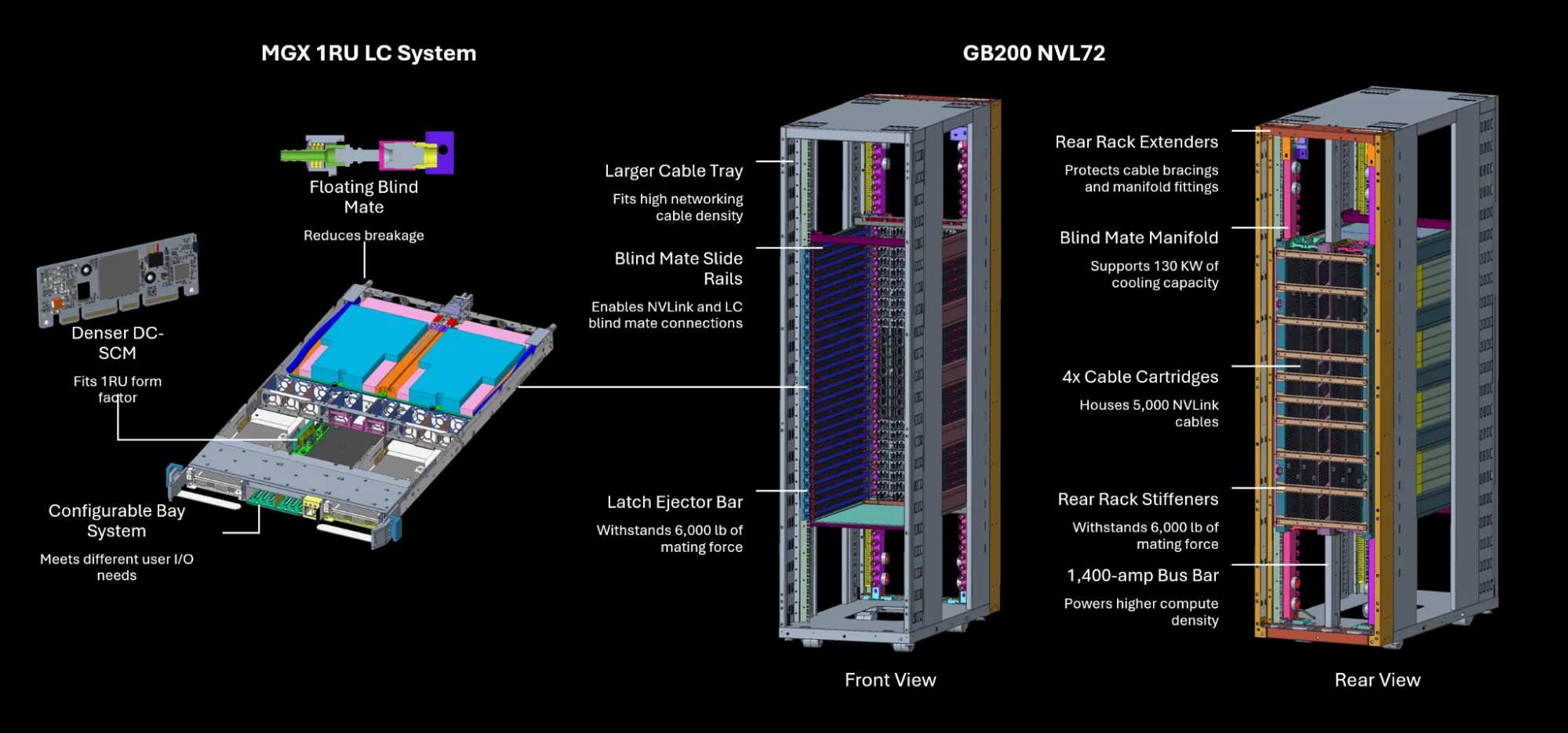
Highlights of NVIDIA’s GB200 NVL72 design contribution to OCP show where cooling, power, and mechanical structures must work together. These are official CAD drawings, not photographs of a Wiwynn factory. Image: NVIDIA Technical Blog, Figure 4.
Common specifications reduce the work partners must do from scratch, while directing development resources toward the same interfaces and configurations. As customers prepare to deploy the platform, demand takes shape for compatible cold plates, pipes, connectors, and integration services. An alternative cooling system must demonstrate its thermal performance and persuade customers to accept a different deployment arrangement.
This reveals a difference in power worth examining in Wiwynn’s experience. Suppliers control engineering and manufacturing capabilities; platform companies can use system design to influence where those capabilities are directed. Hong’s account linking the failed investment to NVIDIA’s choice reflects that gap: producing test samples and achieving enough adoption to support a factory are different milestones.
For suppliers, the risk therefore changes as investment progresses. During development and sample delivery, the main commitments are engineering time and testing resources. Once factory construction begins, a technological judgment becomes tied to physical assets that are harder to adjust. A customer’s willingness to test is an important signal, but investing in a factory requires stronger evidence of how widely the solution will be adopted.
Once the Path Is Set, the Work Extends into the Data Center
Wiwynn’s options go beyond choosing between cooling technologies. They also include deploying whichever system customers ultimately adopt.
Hong says Wiwynn initially outsourced manufacturing to Wistron, then decided in 2019 to gradually bring it under its own control. As customers grew larger and collaboration became closer, it became harder to keep routing technical exchanges and quality control through a third party. More complex AI equipment also increased the need for manufacturing engineering to feed directly back into design.
That capability found a more concrete application in a data center project. When Wiwynn took on an AI data center project for Malaysia’s YTL Group, the GB200’s use of liquid cooling required the two companies to plan the facility’s water and electrical systems together. The customer also sent staff to Wiwynn’s factory in Luzhu, Kaohsiung, to learn how to install liquid-cooling equipment. Wiwynn’s work extended from delivering completed racks to connecting them, planning the network, and integrating equipment on site.
The example shows how much deployment work remains after a platform has established the technological direction. For customers, compatibility with specifications is a starting point. Cooling, power, and equipment installation must be coordinated to get a set of racks operating in a data center. Suppliers can build value through these tasks, but their investment must follow the path customers actually adopt.
Knowing When to Stop Matters as Much as Knowing When to Invest
Hong says Wiwynn began amortizing the immersion-cooling investment once it recognized that conditions were turning against it, completing the process in about six months. She also acknowledged that, as the company grew, decisions could no longer rely on intuition as they had in its early days.
Investing ahead of demand and controlling risk often happen at different times. While the technology remains unsettled, suppliers need to build samples and capabilities to have a chance of participating in the next generation of products. As adoption becomes clearer, they must reassess which investments to expand and which to stop. Money already spent cannot substitute for evidence of what customers will buy next.
The half-factory Wiwynn dismantled makes that trade-off tangible: rising AI demand will not make every supporting technology succeed at once. As a platform’s choices translate into orders and deployment at scale, suppliers need both the ability to keep pace and the resolve to stop investing elsewhere.
Sources
- Tingwei Wang, interview and editing, “Building Taiwan’s Youngest and Most Profitable NT$1 Trillion Company in 14 Years: Wiwynn’s Emily Hong Says, ‘Act Boldly!’” Business Weekly, no. 2032, pp. 66–69.
- Wiwynn, “Wiwynn Boosts Two-phase Immersion Cooling Development by Investing in Technology Leader LiquidStack,” March 25, 2021.
- Ivan Goldwasser et al., “NVIDIA GB200 NVL72 Delivers Trillion-Parameter LLM Training and Real-Time Inference,” NVIDIA Technical Blog.
- Amr Elmeleegy, “NVIDIA Contributes NVIDIA GB200 NVL72 Designs to Open Compute Project,” NVIDIA Technical Blog.
- Meng-Hsuan Yang, “Wiwynn Pursues Major Orders in Malaysia and Builds an NVIDIA-Certified Data Center; Emily Hong: ‘If We Dare to Go, We Must Help the Local Economy Thrive,’” CommonWealth Magazine, no. 833.