
United Alloy-Tech did not invent a new cooling technology from scratch. It found a new market for the sealing, welding, surface-treatment, and large metal enclosure capabilities that it had already developed for electric vehicle battery housings.
That distinction matters. UAT’s move into AI liquid cooling may look like another auto-parts supplier chasing a popular theme. In practice, the company is transferring a mature manufacturing skill set into a market where failure is far more expensive and reliable production can command a higher price.
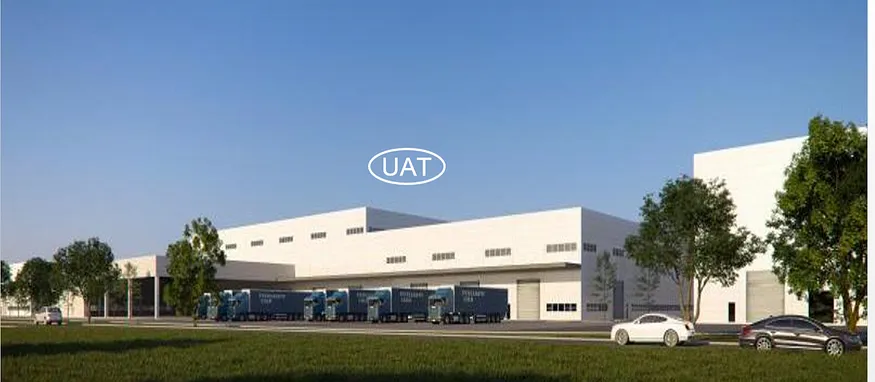
An official rendering of a United Alloy-Tech manufacturing facility. Image: United Alloy-Tech.
UAT’s Entry Point Is Sealing and Precision Manufacturing
United Alloy-Tech Company (UAT, 精確實業) is applying its experience with airtight EV battery enclosures to liquid-cooling racks and manifolds. The products serve different industries, but they share three basic requirements. Liquids must not escape. Dimensions must remain within tolerance. Production must remain stable as volume increases.
This is the most important part of UAT’s transition. The company is not starting from zero. It is finding a new way to price manufacturing capabilities that it already owns. Automotive components provide an established revenue base. AI liquid cooling offers the possibility of faster growth and higher margins.
Why AI Servers Are Bringing Liquid Cooling to the Foreground
The power consumption and heat density of AI servers are rising quickly. Traditional air cooling is moving closer to its practical limits. A report on the Nvidia GB200 supply chain said that its heavy thermal load was pushing server racks toward broad adoption of liquid cooling. The report estimated that the related cooling components could cost 15 to 20 times as much as those in a traditional air-cooled rack.
This change is creating more than a market for one new component. It requires a complete fluid system.
Cold plates carry heat away from processors. Manifolds distribute coolant to individual computing nodes. Coolant distribution units, or CDUs, manage temperature, pressure, and flow. Quick disconnects support maintenance by limiting coolant release when connections are separated. Actual spill performance depends on the coupling design, operating conditions, and correct use; the component category alone is not a zero-leak guarantee. CPC’s connector-selection guide explains why coupling selection varies with location and proximity to sensitive electronics.
In a rack filled with expensive computing equipment, preventing leaks is not a minor manufacturing detail. It is a matter of reliability and risk control.
The First Order Came From the Similarities Between Battery Housings and Server Racks
In early 2025, UAT approached a cloud service provider. The customer did not immediately show much interest. Near the end of the meeting, however, it asked whether UAT would be willing to take on an immersion-cooling rack.
After examining the product, UAT’s team recognized several similarities to an EV battery enclosure. Both are large metal structures. Both require tight control over sealing, cleanliness, surface treatment, weight, and machining precision. UAT promised to deliver a sample within one month.
The company assigned 18 people to the project. The sample passed qualification on its first attempt. UAT then won an order for 70 racks and shipped them in the fourth quarter of 2025.
The significance of that first order went beyond its value. It showed that a new customer was willing to accept manufacturing processes originally developed for the automotive industry. UAT later said that another three or four customers had approached the company and that it had taken on more than 20 projects in total.
The speed is impressive, but speed alone does not explain the result. Delivering a sample in one month would have been a gamble without UAT’s existing experience in welding, flatness control, and leak prevention. Speed was the outcome. Transferable process know-how was the underlying reason.
Blind-Mate Manifolds Are a More Difficult Mass-Production Test
The manufacturing challenge becomes more demanding with blind-mate manifolds. Space inside a rack is tight, and engineers cannot directly see every connection point. The pipes must therefore connect accurately under limited visibility. Even a small welding deviation can create a coolant leak.
When Cooler Master Co., Ltd. (訊凱國際) sourced manifolds from UAT, it paid particular attention to the company’s control of precision-welding temperatures. It also valued UAT’s ability to integrate large equipment and maintain accuracy after moving a production line.
These requirements show why the opportunity is not simply about producing metal boxes. A qualified supplier must keep dimensions, welding quality, and sealing performance consistent across repeated production. That is where years of automotive manufacturing discipline can become commercially useful in a new market.
This Is UAT’s Third Transfer of Its Core Capabilities
UAT began as a bicycle-parts manufacturer. It later suffered consecutive losses as competition intensified. In 2017, Minth Group Limited (敏實集團) acquired a 44 percent stake. UAT then started moving into the automotive supply chain.
The company first produced battery-enclosure separators for Volkswagen Group (福斯集團). It later supplied battery enclosures and structural components to Chinese electric vehicle manufacturers. According to Business Weekly Taiwan, UAT’s revenue grew by about 12 times between 2017 and 2025, and the company returned to profitability.
This history changes how its liquid-cooling move should be understood. UAT is not becoming a technology company overnight. It has repeatedly moved its metal die-casting, machining, welding, and enclosure expertise into applications with greater value.
The move from bicycles to automobiles was one transfer. The move from conventional auto parts to EV battery structures was another. AI liquid cooling is the third.
Taiwan’s Strength Is Manufacturing, but System Control Remains the Weak Point
Taiwanese suppliers do not lead every part of the liquid-cooling supply chain. Cold plates and manifolds are closer to Taiwan’s established metalworking strengths. Companies such as Asia Vital Components Co., Ltd. (AVC, 奇鋐科技) and Hon Hai Technology Group (Foxconn, 鴻海科技集團) have advantages in these areas.
CDUs and quick disconnects present a different challenge. They require expertise in fluid control, long-term reliability, and on-site maintenance. European and American suppliers such as Vertiv Holdings Co. and Boyd Corporation held stronger positions in these areas during the market’s early development.
This division of labor creates both an opportunity and a limit for UAT. Its sealing and precision-manufacturing experience gives it a credible entry point. However, the companies that control more of the cooling system may have greater influence over specifications, customer relationships, and value distribution.
The reported delivery of 70 racks is evidence of an initial manufacturing order, not a record of repeat demand or long-term field reliability. Subsequent orders would show whether the customer relationship is expanding; operating data would show how the racks perform after installation.
Responsibility after delivery also matters. The sources cited here do not establish which party handles field maintenance or bears the cost of a leak. Those obligations affect the economics of supplying cooling hardware, so they should remain separate from claims about machining capability or the number of projects under discussion.
References
-
羅之盈, “精確實業靠防漏技術搶AI液冷商機” [How UAT Uses Leak-Prevention Know-How to Enter AI Liquid Cooling], Business Today (今周刊), №1550, September 2, 2026.
-
高士閔, “從瀕倒自行車廠到AI液冷新星:精確8年營收翻12倍浴火重生記” [From a Failing Bicycle-Parts Maker to an AI Liquid-Cooling Contender: How UAT Increased Revenue Twelvefold in Eight Years], Business Weekly Taiwan (商業周刊), №2017, July 9, 2026.
-
楊孟軒, “輝達GB200揭開散熱新時代!液冷價格躍升15倍,7家台廠已搶進供應鏈” [Nvidia GB200 Opens a New Cooling Era: Liquid-Cooling Prices Rise Fifteenfold as Seven Taiwanese Suppliers Enter the Supply Chain], CommonWealth Magazine (天下雜誌), №812, November 26, 2024.
-
Ministry of Economic Affairs, Taiwan, “United Alloy-Tech Company,” official public company registry. Full public profile accessed September 4, 2026. https://findbiz.nat.gov.tw/fts/company/86406401?fhl=en
Updated Oct 16, 2026