
As TSMC expanded its advanced chipmaking capacity in Taiwan, another group of engineers was working to find somewhere for the fabs’ wastewater to go. In Baoshan, Hsinchu, Zongming Liao, a general manager at Forest Water Environmental Engineering, rented generators to get a wastewater treatment plant ready for trial operation before its electricity connection was in place. In Nanzih, Kaohsiung, a facility originally designed for municipal sewage had to keep serving existing users while upgrading its equipment to accept process wastewater that TSMC had pretreated inside its fabs.
These projects rarely feature in discussions of chipmaking capacity. Progress at a new fab is usually described through construction milestones, equipment installation, and process qualification. But water has its own preparation schedule: a reliable source must be available before it reaches the fab, its quality must meet the requirements of manufacturing, and treatment facilities must be ready to handle it after use.
When different companies and government agencies are responsible for these schedules, coordinating water infrastructure becomes part of capacity planning. For international readers following TSMC’s supply chain, the pipes and treatment equipment beyond the fab’s perimeter belong in the picture, too.
Reclaimed Water Still Has Further to Go
Understanding semiconductor water use requires distinguishing at least three stages. Treated municipal sewage or industrial wastewater can become reclaimed water. A fab then treats that water further according to its intended use, with process water required to meet purified or ultrapure water specifications. After use, process wastewater is separated according to its composition and suitability for recovery: some is reused, while the rest goes on to further wastewater treatment.
Reclaimed water delivered to a fab and ultrapure water that comes into contact with wafers are therefore at different treatment stages. Stable water quality upstream helps downstream purification systems operate under more predictable conditions. Supply volume and water quality have to be considered together.
Urea presents one specific challenge. In developing a high-sensitivity urea detection system, Taiwan’s Industrial Technology Research Institute (ITRI) noted that other constituents in reclaimed water can interfere with existing testing equipment, affecting on-site measurements and the dosing of treatment chemicals. Removing impurities requires consistently accurate measurements, making water monitoring part of treatment capability.
Forest Water chairperson Youchi Kuo’s account of the Yongkang plant brings the issue back to local conditions. Her team investigated unusual water quality fluctuations and traced them to seawater flowing back with the tides. It responded by adjusting operating parameters ahead of high tide and allowing a buffer. The same equipment still requires appropriate operating experience when the incoming water changes.
A fab’s ability to obtain a steady supply of water that meets its specifications depends on the continued operation of upstream sewage collection, treatment, and monitoring systems. For a water services provider, completing construction is followed by the long-term work of maintaining supply quality.
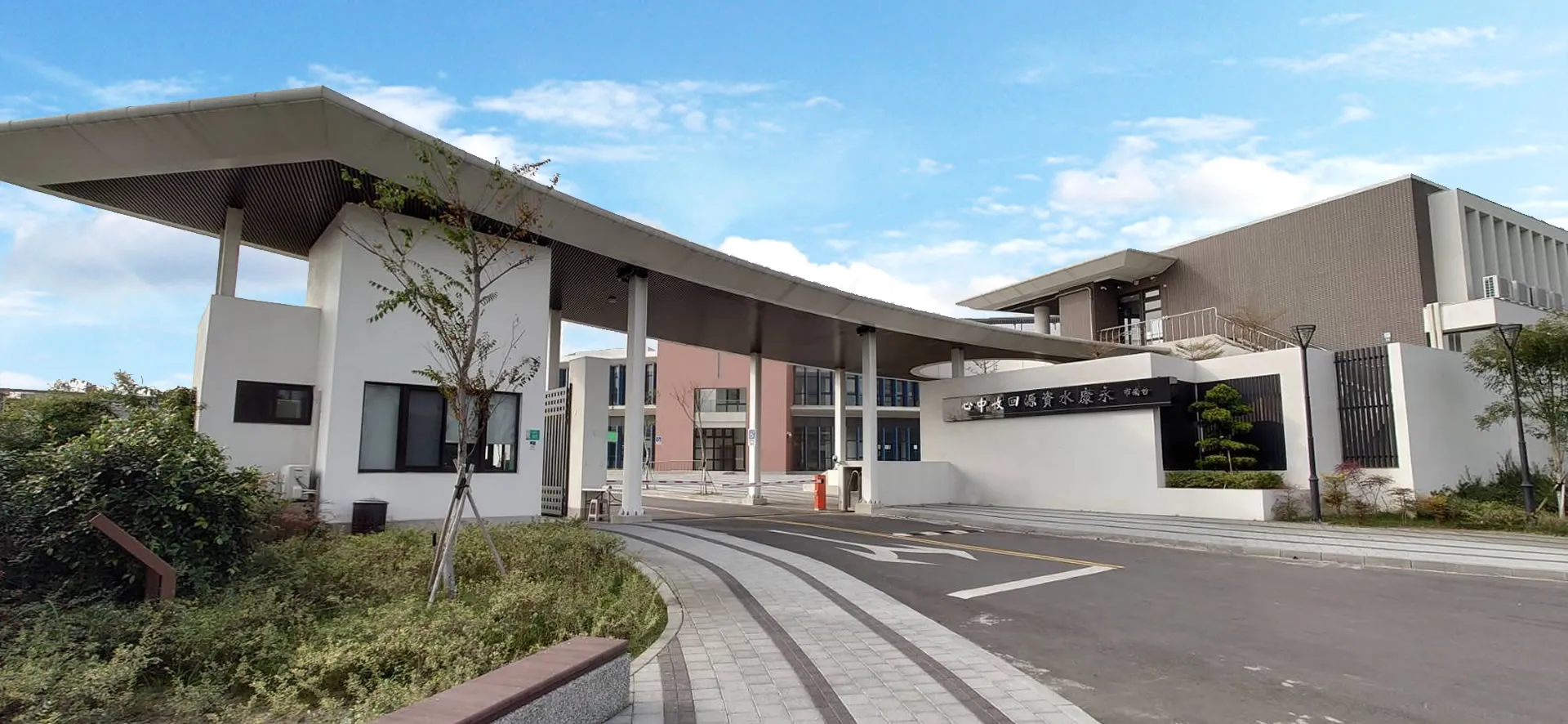
Entrance to the Yongkang Water Reclamation Plant in Tainan. Image: Forest Water Environmental Engineering.
Supply and Discharge Each Need Their Own Infrastructure
TSMC’s Southern Taiwan Science Park Reclaimed Water Plant illustrates another part of the system. Built in collaboration with CTCI Group, the facility began supplying water in 2022. It processes effluent from the science park’s wastewater treatment plant into industrial reclaimed water, while also checking the quality of municipal reclaimed water arriving from Yongkang and Anping before supplying the fabs. Water production, monitoring, and delivery are coordinated within the same arrangement.
That arrangement went through research and development, pilot operation, and stability testing. Teams from TSMC, ITRI, and CTCI had to refine technologies and operating procedures together to move reclaimed water from experiments into actual supply. Building a treatment plant and consistently delivering water that meets specifications require both engineering and operating capabilities.
Wastewater discharge at the other end also affects production conditions. The Hsinchu Science Park Bureau commissioned the Baoshan Phase 2 wastewater treatment project to support the park’s expansion. After a fab recovers and reuses process wastewater, the remaining discharge still needs an appropriate treatment destination. Increasing reuse therefore also requires coordinating the recovery system with downstream treatment.
Nanzih makes the difference between the supply and discharge schedules particularly clear. Forest Water first modified an existing sewage treatment facility to accept process wastewater. A separate Nanzih water reclamation plant project had its first-phase completion scheduled for the end of 2028 in plans published by Kaohsiung’s Water Resources Bureau in late 2025. One facility handles water after use; the other is being built to produce reclaimed water for industry. Each addresses a different need within the water cycle.
This makes coordination a practical scheduling task. When will a new fab begin discharging wastewater? Can existing facilities accept it? What pretreatment is required? When will additional reclaimed water become available? These questions have to fit into the same timetable. The capabilities and delivery schedules of water facilities affect how much interim provision a fab needs to make.
Upstream of Reclaimed Water Is Still a City
Municipal reclaimed water can expand the supply available to industry, but its potential volume starts with a city’s sewage collection capacity. How much water the sewers collect, which plants can reclaim it, and where delivery pipelines reach all affect the volume that can ultimately be supplied.
When the Southern Taiwan Science Park reclaimed water plant opened, Arthur Chuang, then TSMC’s vice president of operations and facilities, identified connections to the sewer network as a prerequisite for developing reclaimed water supplies. Expanding urban infrastructure can turn household wastewater previously outside the collection system into a source that can be planned for and used.
Demographic change is a longer-term consideration. One senior water industry executive cautioned that falling birth rates could affect future municipal wastewater volumes. That effect still needs to be assessed alongside local population movements, household water use, and sewer connections. For capacity planning, the more immediate question is how much water a particular location can actually collect, treat, and deliver when it is needed.
In-house reuse, municipal reclaimed water, and seawater desalination each require different treatment equipment, pipelines, and investment. Planning a mix of sources allows a new fab to arrange alternatives ahead of time if one facility is not yet ready or a particular source is constrained.
TSMC’s expansion also takes some of the investment and coordination work beyond the fab itself. Assessing additional capacity involves three questions alongside equipment and electricity: when water that meets specifications can arrive, who will handle process wastewater, and whether infrastructure at both ends will be ready for production. The answers often lie in the design and construction plans for local water facilities.
Sources
- Zhaoyuan Yuan, “The Semiconductor Water Supply Battle: Why Even TSMC’s Reclaimed Water for 2nm Faces a Falling Birth Rate,” CommonWealth Magazine.
- Yuehua Cao, “Back from Losses: The Water Company Supporting TSMC and UMC,” Business Today, issue 1536, selected edition.
- Zhanghan Zhong, “‘TSMC Won’t Compete with Anyone for Water’: The Challenge of Reusing Wastewater in Advanced Chipmaking,” CommonWealth Magazine, issue 759.
- TSMC, “TSMC’s Southern Taiwan Science Park Reclaimed Water Plant Begins Supply, Pioneering Industrial Reclaimed Water Reuse in Semiconductor Manufacturing,” October 4, 2022.
- Industrial Technology Research Institute, “High-Sensitivity High-Matrix Urea Detection System.”
- Hsinchu Science Park Bureau, “Hsinchu Science Park Baoshan Phase 2 Expansion: Wastewater Treatment Plant Project.”
- Water Resources Bureau, Kaohsiung City Government, “Kaohsiung Nanzih Water Reclamation Plant Build-Transfer-Operate Project,” December 2, 2025.