
TSMC can build semiconductor fabs in the United States, but its suppliers may not be able to follow at the same pace. A materials or equipment service company might start by renting an office, then establish a warehouse, and only invest in production once orders, a team, and local operating experience are in place. For the semiconductor manufacturing capacity the United States hopes to build, that gap affects how much maintenance, materials supply, and workforce training can take root alongside the fabs.
TSMC, the Taiwanese foundry that manufactures chips for chip designers, is turning its Arizona expansion into a broader challenge of establishing an industrial ecosystem. Steve Hsu, Arizona’s trade and investment representative in Taiwan, observes that Taiwanese businesses exploring the area now extend to fasteners, warehousing, finance, and everyday services. His greater concern is whether the surrounding suppliers have enough people and management capacity to support TSMC’s expansion across multiple overseas locations.
That adds another measure of progress for semiconductor manufacturing in the United States and Europe. A large chipmaker can concentrate resources to carry out an investment. A sustainable industrial cluster also requires much smaller companies to be able to do business nearby and afford the teams they need.
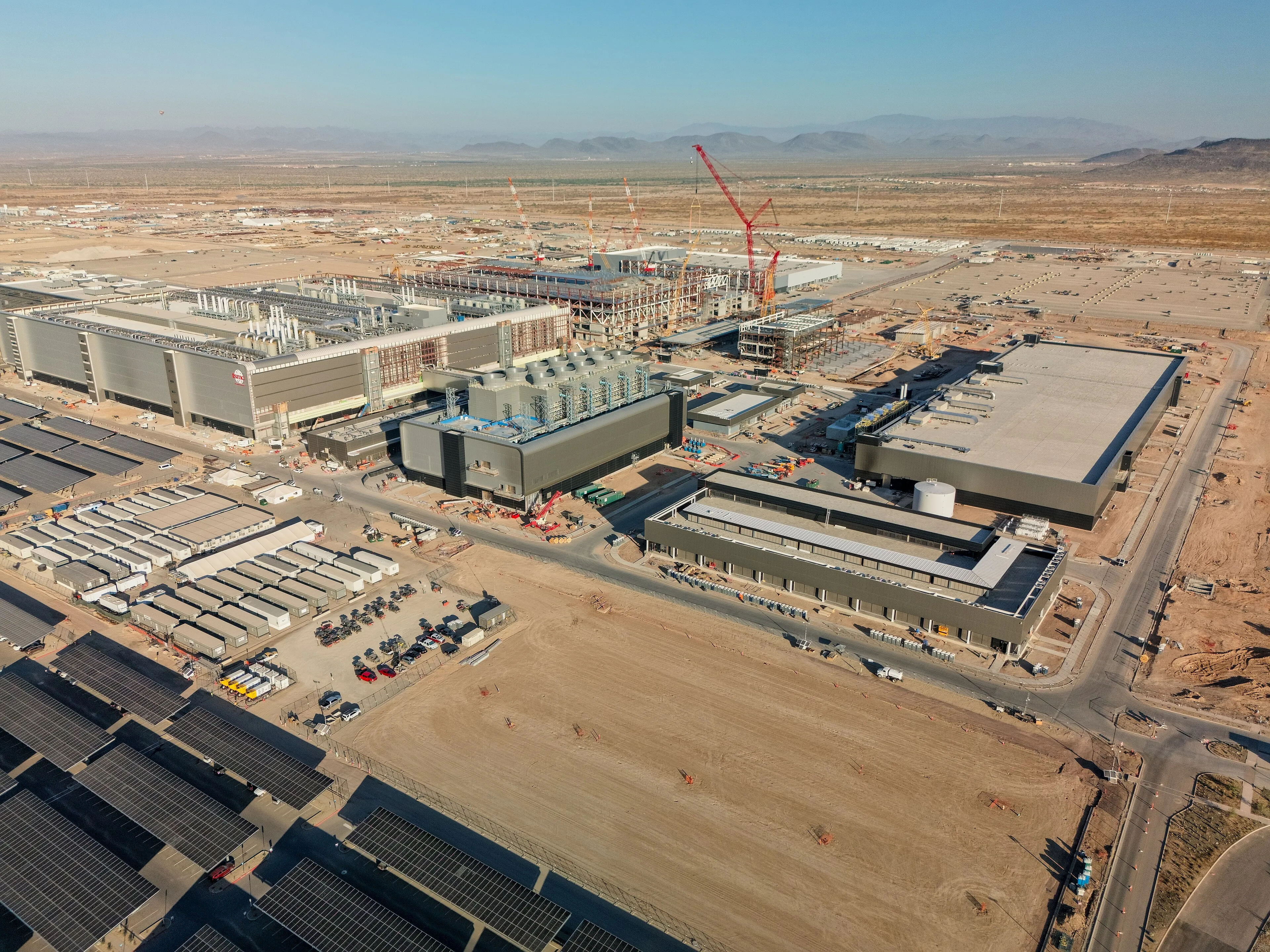
TSMC’s Fab 21 campus under construction in Phoenix, Arizona, on November 5, 2023. Photo: Hunter Trick (TrickHunter), via Wikimedia Commons, CC BY-SA 4.0. Displayed at a reduced resolution; no cropping or other edits.

Fabs and suppliers invest on different timelines
Hsu describes a sequence for suppliers entering the United States: establish an office to develop business; once customers are secured, add a warehouse to handle inventory, installation, testing, repairs, and returns; then consider a factory as demand grows, a team develops, and the company becomes familiar with local employment, tax, and financial requirements. Behind that sequence is the need to establish whether revenue can support the additional fixed costs.
Taiwanese semiconductor consumables supplier Yeedex Electronic offers a concrete example. According to an article in issue 820 of CommonWealth Magazine, Yeedex and other companies worked together through TSS Holdings to share Gudeng’s U.S. office and warehousing and logistics resources. Yeedex airfreighted sealing rings made in Taiwan to Gudeng’s Phoenix warehouse, from which trucks could deliver them to a customer’s facility in about 30 minutes. For a smaller supplier, that made nearby supply possible without immediately taking on the full cost of U.S. manufacturing.
The arrangement also illustrates the different layers of localization. A warehouse can shorten a customer’s wait for parts while the products themselves are still made overseas. Growing local wafer capacity strengthens the incentive for suppliers to invest, but each company must still assess whether demand is sufficient and factory utilization can be sustained. Between a fab expansion announcement and a supply chain capable of local production lies a gap that orders and operating experience must fill.
Shared warehouses and service locations may therefore help broaden supplier participation by reducing the cost of entry. For U.S. and European buyers seeking supply chain resilience, it also matters which critical items can already be manufactured locally, which are simply held in larger inventories, and which equipment failures still require support from overseas personnel. Each addresses a different risk.
Smaller suppliers need another way to build facilities
Once a supplier is willing to establish production, a second problem emerges: manufacturing expertise does not necessarily come with the ability to develop property overseas.
Hsu proposes a division of responsibilities in which professional developers bring together financing, design, and local construction teams, build facilities, and lease them to technology companies. Suppliers can keep their capital and management attention focused on equipment, people, and customer service. Developers can accumulate experience through repeated projects, standardized materials, and procurement. He sees this as offering a better chance of controlling costs than having every smaller supplier work out land acquisition and construction on its own.
Leasing still requires someone to bear construction costs, and enough demand to support long-term commitments. The value of this division lies in assigning land, construction, and financing risks to parties equipped to manage them. A supplier does not have to build an entire property development capability for a single location. If several companies can share suitable infrastructure, the entry barrier may fall further.
Halo Vista, adjacent to TSMC’s campus, reflects this broader demand for supporting facilities. The developer’s plans encompass advanced manufacturing, research and development, housing, and everyday amenities. Suppliers need industrial space, employees need homes, and research and service teams need workplaces. These requirements are being incorporated into a single area’s development plan rather than left entirely to the chipmaker to provide. Halo Vista development plans
Being able to rent a facility, however, does not by itself create a team capable of working independently on the ground.
Military skills need a route into semiconductor work
Hsu suggests that U.S. veterans and service members preparing to leave the military could provide a source of talent for the supply chain. He points to experience in equipment operation and maintenance, communications, warehousing, and logistics management, and wants to connect military occupational skills with factory roles. This broadens the recruiting pool from people who already have semiconductor experience to those with relevant technical foundations who can be trained further.
TSMC is already reaching this group. An event listing published by Be Connected, a program of the Arizona Coalition for Military Families, described a TSMC Arizona hiring event for veterans and service members on October 3, 2026, with full-time, contract, and SkillBridge opportunities. A recruiting channel is already in place; training and retention outcomes across the different roles remain the next things to assess. Be Connected event listing
SkillBridge offers career transition opportunities before military separation. Eligible active-duty service members who receive approval can participate in training during the applicable period before leaving service, while retaining military pay and benefits. Arrangements must comply with their service branch’s requirements and approval conditions. For employers, this provides earlier access to potential recruits, while still requiring investment in mentoring, job design, and management. U.S. Department of Transportation SkillBridge guidance
Semiconductor jobs also demand more specific skills than simply knowing how to operate machinery. TSMC’s technician apprenticeship program combines on-the-job training with instruction from community colleges and other educational institutions. Roles cover facilities systems, process monitoring, and equipment maintenance. They require troubleshooting, adherence to safety procedures, and an understanding of particular tools and production environments. Military experience can provide a starting point, followed by further professional learning inside the factory. TSMC Technician Apprenticeship Program
Training capacity must reach the suppliers
A company of TSMC’s scale has a larger organization to support recruiting channels, mentors, and course development. Hsu’s concern is the surrounding businesses: if suppliers cannot recruit and train people, the anchor company’s own hiring success will not be enough to complete the cluster.
He proposes joint training by several Taiwanese companies, with experienced factory practitioners teaching hands-on skills and cross-cultural training included. This remains an initiative he hopes to advance. Its significance is that it treats workforce development as something the supply chain can tackle together, so that no single company has to carry all the upfront investment alone.
Suppliers’ own experience shows how difficult that investment is to avoid. Rayzher Industrial installs the gas hook-up piping that connects fab supply systems to process tools. Interviewed in issue 850 of CommonWealth Magazine, Ku-Hua Chou, chief operating officer of its innovation business group, said facilities engineering technicians need at least six months of training, and realistically more than a year, to become technically effective. Rayzher wants to replicate its training methods overseas because Taiwan itself does not have enough people to spare.
Overseas expansion therefore also requires turning experienced practitioners’ knowledge into methods that can be taught, assessed, and applied at different sites. Experience in equipment maintenance, welding, or logistics can shorten part of the learning process. Employers must still develop the skills required by particular factory specifications, safety procedures, and customer requirements. Shared courses that establish foundational skills, followed by specialized training at each company, could help turn a broader recruiting pool into a sustainable workforce.
Pay, shift arrangements, career progression, and workplace management will also influence whether trainees stay. Treating military backgrounds as clues for matching skills to jobs offers employers a more useful basis for designing roles and training than assuming veterans are inherently suited to factory work.
The surrounding city is part of manufacturing capacity
Retention also depends on life outside the factory. Hsu notes that as Taiwanese families relocate, children’s schooling and continuity between education systems are becoming more prominent needs. When companies want experienced staff to lead local teams over the long term, housing, education, and family relocation affect both assignments and retention. Expanding these services may also draw in other industries and make the cluster attractive to a wider range of workers.
Europe can draw on the approach of connecting existing skills to new jobs, rather than simply copying the U.S. recruiting pool. ESMC, TSMC’s joint venture with Bosch, Infineon, and NXP, recruits professionals in electrical engineering, mechatronics, mechanical engineering, and facilities maintenance in Dresden. It also arranges training in Taiwan lasting three to twelve months, depending on the role. Existing industrial experience likewise needs company-organized training to connect it with fab operations. ESMC technician recruitment and training
U.S. veterans and German mechatronics specialists offer different starting points. The shared task is to help these workers support equipment, materials, facilities, and logistics companies as well as the anchor chipmaker. When suppliers can afford a lasting local presence, local teams can resolve customer problems independently, and those teams can keep training the next group of workers, the area around a fab begins to develop industrial capabilities that can endure.
TSMC’s expansion creates demand and opportunities for cooperation. The next stage’s results will show up in smaller details: whether a consumable can be replenished on time, whether a local piping team can be established, and whether a trained technician chooses to stay. As those conditions fall into place, large investment commitments can become businesses that the surrounding suppliers can sustain.
Sources
- Business Next, EP317, “Fab Spillovers Become Town Building: Could Veterans Be a Key Workforce for TSMC’s U.S. Fab? Featuring Steve Hsu, Arizona’s Representative in Taiwan,” October 28, 2026.
- Yiyun Huang, “Following TSMC to America Is Expensive, but Staying Behind Risks Replacement: Semiconductor Suppliers Team Up,” CommonWealth Magazine, issue 820.
- Yiyun Huang, “The Team Behind TSMC’s Overseas Expansion: Rayzher’s 20 Years of Piping Expertise Protect the Final Connection to Chipmaking Tools,” CommonWealth Magazine, issue 850.
- Halo Vista, “About Halo Vista.”
- Arizona Coalition for Military Families / Be Connected, “TSMC Hiring Event,” October 3, 2026 event.
- U.S. Department of Transportation, “1DOT SkillBridge Program.”
- TSMC, “Technician Apprenticeship Program.”
- Hunter Trick (TrickHunter), “231105-1 TSMC Fab 21 construction,” November 5, 2023, Wikimedia Commons, CC BY-SA 4.0.
- ESMC, “Technicians.”