
This article is adapted from an Sidechat Podcast interview with Dr. Wang Yuh-Jyh, CEO of Tron Future. Company plans and relative time references reflect the discussion summarized in November 2025.
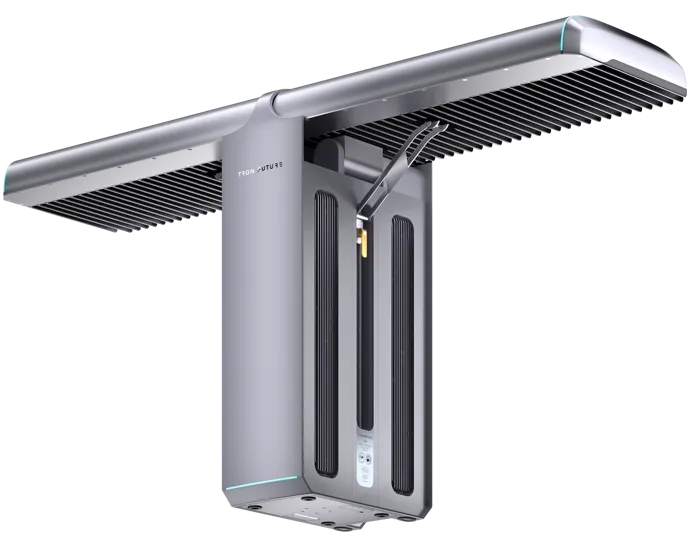
T.Radar product rendering from Tron Future’s official website, accessed October 16, 2026. This is a product illustration, not a photograph of the evaluation discussed in the original interview. Image: Tron Future.
The Spark: Seeing the Commercial Potential of Radar Technology
The founder of Tron Future, a Ph.D. in Electrical Engineering from Caltech, began his research into Passive Electronically Scanned Array (PESA) radar during his doctoral studies. After returning to Taiwan to teach (at National Yang Ming Chiao Tung University), he continued this research for eight to nine years. The key moment to launch the company came in late 2018, when he judged the technology was mature enough for commercialization and saw immense market potential. He decided to leave academia and bring his research to the market.
Founded in late 2018, the company’s initial operating capital came from the founding team (tens of millions of NTD), supplemented by crucial early orders from the Taiwan Space Agency (TASA) and other clients. This allowed the company to sustain operations through its first few years. However, about two or three years ago, market demand suddenly accelerated. To avoid falling behind international peers who were investing heavily, Tron Future opted for a Series A funding round, harnessing the power of the capital market to accelerate growth and pull significantly ahead of its domestic competitors.
Riding the Wave of a Domestic Space Industry
Tron Future’s establishment in late 2018 coincided with the rise of global Defense Tech startups like Anduril (est. early 2017) and Shield AI (est. 2016). At the time, however, the company did not anticipate that defense or space would become mainstream sectors. Even after securing the TASA order, the prospect of a “Taiwanese space industry” felt distant.
In reality, TASA has been around for over 30 years. Its first-phase plan involved procuring foreign equipment. The second phase focused on purchasing components for domestic assembly (like the Formosat-5 satellite). It wasn’t until the third-phase plan, initiated in 2018, that “maximizing domestic production” (indigenization) became a primary objective.
Tron Future was a direct beneficiary of this third-phase plan. When TASA began searching for domestic vendors, it discovered the startup and its relevant technology. Looking back, when public hearings were held for Taiwan’s Space Industry Development Act, Tron Future was the only industry representative in attendance. Just four years later, LEO (Low Earth Orbit) satellites have become a hot-button topic, reflecting a speed of development that was entirely unexpected.
From Civilian to Defense: An Unintended Pivot to Counter-UAS
The company’s entry into the defense sector was similarly an accidental pivot. The earliest applications for its radar were civilian, such as monitoring birds at power plants to prevent bird strikes. However, while attending an international exhibition during its first year, the team discovered an extremely strong market demand for “drone detection.”
Consequently, about five years ago (circa 2019–2020), the company shifted its focus to detecting unmanned aerial systems (UAS). As armed conflict (in Ukraine) erupted approximately three years ago, customer demand evolved from simple “detection” to “countermeasures.”
The initial countermeasure (“Soft Kill”) involved radio wave interference (jamming). Early drones were easily downed this way. But in the last three years, drone anti-jamming technology (for GPS and radio) has advanced rapidly. As of last year, drones tethered by fiber-optic cables began appearing on the battlefield; recently, these tethers have extended to 50 kilometers. This means traditional radio-based soft-kill methods are increasingly ineffective, as fiber optics cannot be jammed. This has even led to a new battlefield phenomenon: a landscape littered with fiber-optic cables and a resulting global shortage.
From Soft Kill to Hard Kill: Integrating AI to Counter Drone Swarms
As soft-kill methods lose effectiveness, countermeasures have been forced to escalate to “Hard Kill” — using kinetic weapons to physically shoot down the target. This includes using interceptor drones or integrating with traditional artillery.
The other major challenge is the “swarm.” The threat is no longer one or two drones, but coordinated attacks by dozens or hundreds. This scale is beyond human capacity to manage, mandating the integration of AI for automated threat triage, prioritization, and weapon assignment. This progression has driven the company’s defense-focused development, evolving from simple detection sensors to a comprehensive defense system integrating AI, soft-kill, and hard-kill capabilities.
T.META and T.SwarmMesh: An IoT Where Lives Are at Stake
Tron Future’s system integrates both hardware and software. T.META is the AI combat platform responsible for automated engagement. For example, most armored tanks worldwide currently lack effective counter-UAS (C-UAS) capabilities; the T.META platform can integrate detection and hard-kill weapons to provide that protective layer.
T.SwarmMesh is a secure, mesh-network communication architecture. On the battlefield, information from all dispersed combat units (such as soldiers and armored vehicles) must be linked through a secure network to share situational awareness and enable joint defense.
This system integrates multiple sensors, hard-kill weapons, and even satellite communications, connecting all devices on the “Edge.” It has been described as “a critical Internet of Things (IoT)” — one where failure is not an option.
An Industry Debate on Countermeasure Technology
The founder once engaged in a public debate on LinkedIn with Palmer Luckey, the founder of American defense giant Anduril, regarding C-UAS technology.
The debate began when Anduril released a video showing a small, generator-sized device on a truck. A button was pressed, and an incoming drone swarm immediately fell from the sky. Tron Future commented at the time that achieving this effect — against “so many drones of various types” — with such a small piece of equipment was highly unlikely.
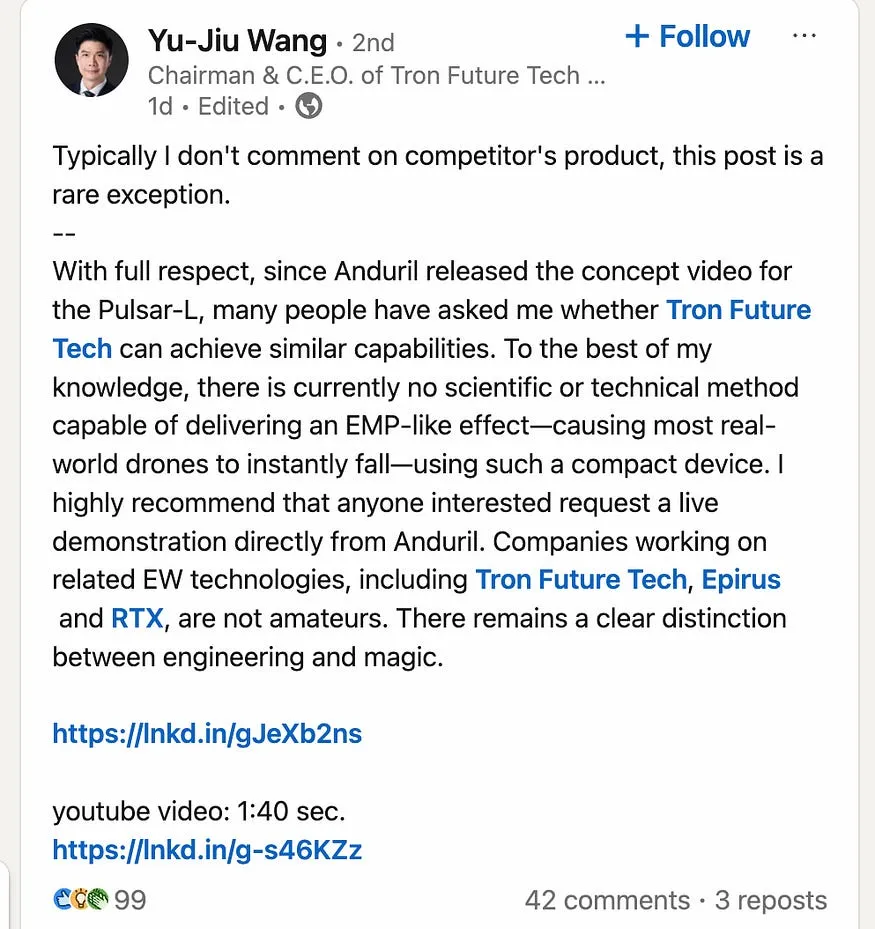
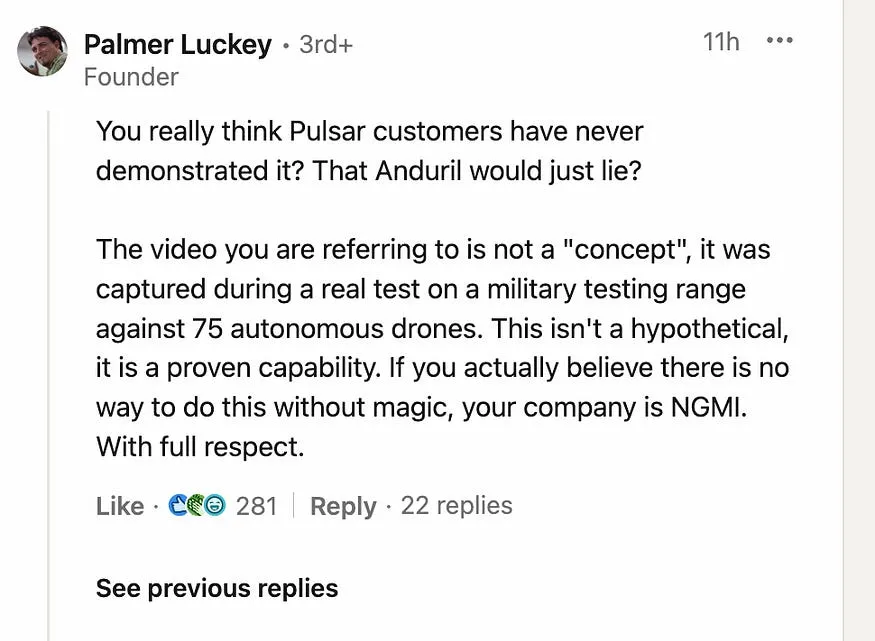
Wang questioned whether the demonstration established effectiveness against a varied drone swarm. Directed-energy systems and radio-frequency jamming have different mechanisms and operating limits; the video alone does not establish which countermeasure would work against every drone type.
A drone’s response to a lost communication link depends on its configuration and control system: it may return, hover, land, or continue a programmed mission. An immediate fall does not, by itself, prove that the electronics were destroyed or establish the power and size required of the countermeasure.
Regulatory Hurdles for Taiwanese Defense Startups
Developing a defense startup in Taiwan involves unique regulatory challenges. For instance, Taiwan’s National Communications Commission (NCC) does not regulate spectrum for “military use.” The problem is that the customers needing C-UAS are not exclusively military.
If the equipment is installed at critical infrastructure, such as a reservoir, that site is not a military zone. To use radio-wave jamming (soft kill) there, one must, by current law, apply for a permit. This creates a bottleneck when responding to immediate threats, though the Executive Yuan and the Ministry of Digital Affairs have been working to resolve these obstacles.
A greater future challenge will likely be “Hard Kill.” The defense industry cannot consist of only chips and circuit boards; eventually, it must involve explosives and propellants, which triggers the Controlling Act for Firearms, Ammunition, and Weaponry. How to legally conduct R&D and manufacturing under government safety supervision is a critical issue the industry must navigate.
Expanding into Space: Building a Sovereign, Rapid-Response Constellation
Tron Future’s next major development focus is space and satellites. Taiwan currently suffers from a critical lack of sovereign, controllable military satellites. In a conflict, relying solely on American or European constellations creates a severe risk of communication cutoff. Whether for naval forces operating offshore or for domestic forces if ground-based stations are destroyed, basic satellite communication is essential to maintain combat capability.
In the interview, Wang described work with TASA on communication satellite technology and plans for at least four satellite launches during 2025–2026 to validate constellation capabilities. This was a forward-looking schedule, not confirmation that the launches had occurred.
The long-term goal is to establish a “Rapid Response Constellation.” This means that as the possibility of conflict rises, Taiwan must have the ability, on short notice, to deploy a basic backup network of tens of satellites (e.g., via SpaceX or Rocket Lab) to ensure sovereign communications.
Strategy: Building a “Red-Free” Supply Chain
Regarding the supply chain, because the company’s early orders came from TASA, it was required from the outset to “exclude the Red supply chain” (i.e., mainland China). As a result, Tron Future’s bill of materials has been over 99% “Red-free” since its inception.
Defense and space customers can impose different supply-chain and procurement requirements. Wang discussed how a supplier’s existing customer relationships may affect prospective buyers. Those examples should not be read as general statements about which countries regard each other as adversaries or will refuse to buy the same equipment.
The Global Defense Market: The Best Era Since the 1990s
The current global defense market is in its best era since the 1990–1991 Gulf War. In the 35 years following the collapse of the Soviet Union, the U.S. lacked a peer competitor, leading to relative complacency in conventional weapons development. During that same period, however, semiconductor, chip, and communications technology advanced to entirely new levels.
Wang argued that the war in Ukraine had exposed gaps in existing equipment and increased demand for new defense technologies. His outlook was for further investment over the following several years; spending decisions and growth rates differ by country.
Much of this demand is for new threat types where solutions do not even exist yet, creating a massive opportunity for startups. In the U.S., Aerospace and Defense (A&D) have always been the same sector; it is a natural evolution for Tron Future to operate in both.
Targeting the US: Taiwan’s Niche Opportunity
As of 2025, Tron Future’s team is just over 300 people. The company plans to enter the U.S. market, which is not only the world’s largest arms exporter but also its largest military spender. Taiwan holds a distinct technological niche and opportunity within the global military division of labor.
System Vision: Toward Fully Automated, System-of-Systems Warfare
The company’s ultimate system vision is to achieve fully automated defense. In the future, when a drone flies into Taiwan’s airspace, the system should automatically track it and, if identified as a threat, automatically neutralize it. If faced with a massive swarm attack, the system should react automatically — an “Iron Dome for drones.”
The next step is to achieve “system-of-systems warfare.” Information from different military branches, armored vehicles, and even individual soldiers is linked via a secure network. This begins with pre-conflict AI satellite reconnaissance to identify enemy deployments, extends to using drones and satellites to track and strike them during a sea transit, and continues even if they land. In a scenario where the main communication network is down, soldiers can use this secure mesh network to share situational awareness, understand their immediate surroundings, and command automated drone assets. Facing its potential threats, Taiwan must rely heavily on automation and AI to mount an effective defense.
Preparing for a 2027 Risk Scenario: Stockpiles and Production Capacity
The discussion used 2027 as a defense-planning horizon, not a prediction that conflict would occur that year. Wang emphasized domestic manufacturing capacity, pointing to the defense-industrial policies pursued under President Tsai Ing-wen and domestic procurement under President Lai Ching-te.
This is an absolute necessity. Taiwan is extremely vulnerable to a blockade. If it cannot indigenously produce weapons (including drones) under blockade conditions, it will quickly “run out of stock.”
While Taiwan is still far from a sufficient level, it is on the right track. For example, the government’s plan to procure 200,000 drones might only represent a few months’ worth of consumption in a real conflict. Therefore, the goal of defense should not be “sufficient stockpiles,” but “mass producibility.”
Ukraine and Russia are now both producing hundreds of thousands of drones per month, many in private homes and basements. Taiwan does not need to maintain this level of peacetime capacity, but it must possess the resilience to “ramp up mass production on demand” across the country when needed.
The Small Drone Threat: The Potential Risk of Smuggled-In Assets
Counter-UAS systems also need to be standardized. Government orders help validate the molds, manufacturing, and production processes to enable rapid wartime scaling. In peacetime, Taiwan might only need one or two thousand C-UAS sets. In wartime, it might consume hundreds per month and must have the ability to produce them.
The interview highlighted the risk that small drones could be concealed inside a country before an attack. Ukraine’s Operation Spiderweb took place on June 1, 2025, as recorded by the Ukrainian president’s office. The operation used drones launched from concealed positions on trucks to attack Russian air bases, illustrating why counter-drone planning must consider threats away from the front line.
For Taiwan, the relevant planning question is how to detect and respond to concealed, short-range launch platforms. The Ukrainian operation does not establish that comparable assets are already present in Taiwan.
The Challenge of Procurement Cycles and the Ukrainian Experience
A major challenge for current defense planning is that drone technology iterates extremely quickly, while government procurement cycles often take two years for delivery. By the time the product arrives, its specifications may be obsolete against new threats.
Ukraine has adopted a progressive wartime strategy: delegating procurement authority to frontline officers. They report battlefield data (like kill reports) via an app, and the system calculates “credits.” Officers can then use their earned credits to buy the equipment they deem most necessary for the front line. This “gamified” approach ensures that procurement keeps pace with the fluid battlefield — because, as the CEO noted, “buying the wrong gear can be fatal.”
Correction — October 16, 2026: The earlier version dated Operation Spiderweb to June 2024. The operation occurred on June 1, 2025. Satellite schedules and the 2027 discussion have also been clarified as plans and risk scenarios described at the time.
Updated Oct 16, 2026