
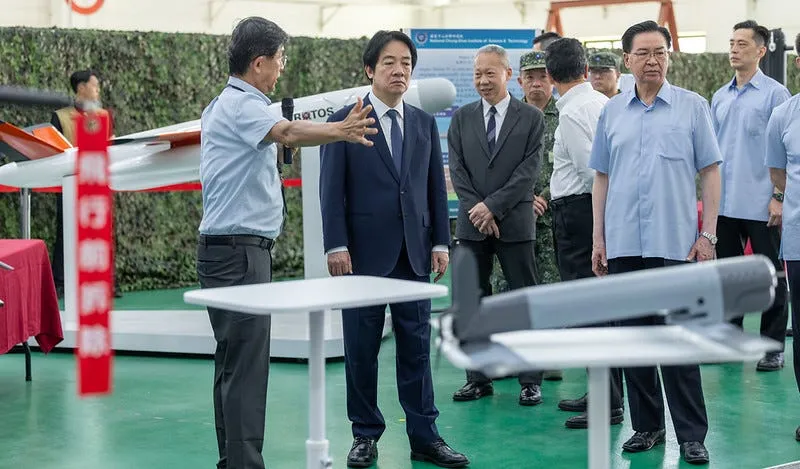
President Lai Ching-te receives a briefing on Taiwan’s anti-radiation unmanned attack system and other drones developed by NCSIST on July 17, 2026. Image source: Office of the President, Republic of China (Taiwan).
Taiwan stopped producing high-emission, high-noise two-stroke motorcycle engines in 2004. More than 20 years later, a technology rejected by the civilian market is returning because of long-range attack drones.
The Tianxia Zero Hour podcast used the Shahed-136 attack drone as an example. One aircraft may cost only US$20,000 to US$50,000, yet it can force an opponent to use an interceptor missile worth more than US$1 million. In this kind of cost exchange, maximum engine efficiency, emissions, and service life are no longer the only design goals. Price, weight, range, and ease of production become more important.
This is not a step backward in technology. The mission has changed the definition of good technology.
Long Range Makes Fuel Competitive Again
Agricultural, photography, and short-range reconnaissance drones usually rely on batteries and electric motors. The calculation changes when an aircraft must carry a payload for hundreds of kilometers. Battery weight and endurance become serious constraints.
Fuel-powered endurance depends on the engine, airframe, payload, and flight profile; there is no general conversion from one liter of gasoline to a fixed additional range. Unlike a battery, fuel is consumed during flight, reducing the aircraft’s weight as the mission progresses.
Two-stroke engines fit this requirement well. They are mechanically simple, have a high power-to-weight ratio, and are relatively easy to maintain. They are also cheaper than rotary or four-stroke engines.
According to an assessment by Taiwan’s National Chung-Shan Institute of Science and Technology (NCSIST, 國家中山科學研究院) cited by the podcast, using a two-stroke engine in one attack-drone design could reduce the propulsion-system cost to about one-third of the cost of a four-stroke rotary engine.
Another example comes from a team at the National Yunlin University of Science and Technology (YunTech, 國立雲林科技大學). The team is developing a hybrid propulsion system for drones. Its target is eight hours of flight and a range of 400 to 500 kilometers. An engine generates electricity while electric motors provide propulsion. This design seeks a balance among range, payload, and controllability.
The TPI Bearings Case: Even a Standard Bearing Needs New Operating Parameters
Tung Pei Industrial Co., Ltd. (TPI Bearings, 東培工業) is Taiwan’s largest bearing manufacturer. Its entry into the drone supply chain did not begin with a mysterious new component. The company adapted ball bearings already used in engines to meet a different operating environment.
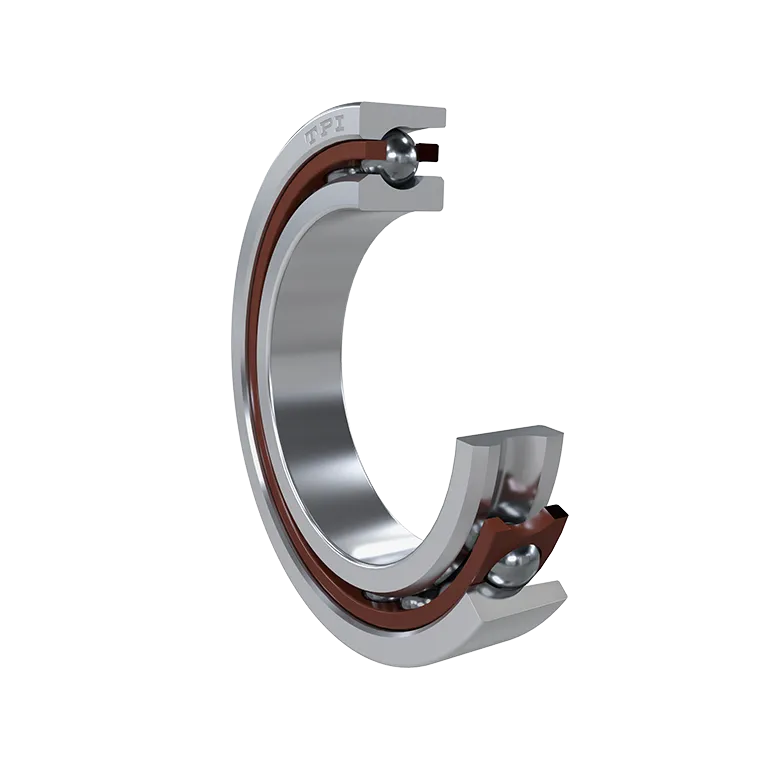
A precision angular-contact ball bearing manufactured by TPI Bearings. Image source: TPI Bearings, Standard Series.
Motorcycle engines commonly use oil-bath lubrication. Drone engines require lubricants that can withstand higher temperatures. High heat and rotational speed also change the thermal expansion of bearings and nearby parts. Internal clearances must therefore be redesigned for the actual operating conditions.
The product may still be classified as a standard bearing. From an engineering perspective, however, it cannot simply be removed from a motorcycle and installed in an aircraft.
These products currently account for less than one-thousandth of TPI Bearings’ annual output of more than 100 million ball bearings. Orders are also unstable, and the company cannot confirm the products’ final applications.
The significance of this case is not that drone bearings have already become a new profit engine. It is that the market has given an established supply chain an entry point into a new industry.
The Motorcycle Supply Chain’s Advantage Is Adaptation Speed
The production value of Taiwan’s motorcycle-component industry has fallen by about 20 percent over the past four years. International manufacturers have shifted production to Southeast Asia, while low-cost Chinese products have added further pressure. Taiwanese suppliers need a new outlet for their manufacturing capacity.
Small-displacement engines, bearings, wiring harnesses, airframe structures, and precision machining are all required in drones. These needs overlap with capabilities that Taiwan’s motorcycle industry has developed over decades.
The individual parts may not have exceptionally high technical barriers. Taiwan’s advantage comes from independent engineering capabilities, a dense supplier network, and the ability to adjust small production runs quickly.
Some Japanese motorcycle manufacturers remain cautious because of their joint-venture relationships and the sensitivity of defense-related business. Taiwanese suppliers may therefore have more room to accept new orders. This is an advantage in supply-chain conversion, not a monopoly based on one component.
International Orders Are Opening a Window
This market is no longer limited to policy statements. According to Wealth Magazine, Taiwan exported about US$212 million worth of drones during the first half of 2026. That amount exceeded the combined total of the previous three years.
In June 2026 alone, Taiwan’s drone exports to Saudi Arabia reached US$47.18 million. These figures suggest that the geopolitical push for a non-China supply chain has started to produce actual purchasing orders.
NCSIST and other government bodies have also visited two-stroke motorcycle and agricultural-engine manufacturers with underused production capacity. They introduced these companies to overseas drone manufacturers, and some orders followed.
Procurement matchmaking by the American Institute in Taiwan (AIT, 美國在台協會) has also connected Taiwanese suppliers with US companies such as Shield AI. According to the report, the Taiwan share of Shield AI’s sourcing rose from less than 1 percent two years ago to 16 percent. The company plans to increase the share to 25 percent within two years.
For motorcycle-component manufacturers, this is a rare open door. An open door, however, is not a long-term competitive moat.
Building a Prototype Is Easier Than Building a Production System
Taiwan has engineers who can build an engine prototype. The more difficult task is assembling a team that can integrate mechanical design, thermal management, combustion, control systems, and aircraft engineering into a product that can be manufactured consistently.
YunTech’s engine project needed an advisory group of 15 professors. A single laboratory could not cover every area of knowledge required by the system.
Prototype production has also exposed problems involving capacity and cost. Another hybrid-engine team documented by Business Weekly needed a cylinder head produced through five-axis machining. One supplier quoted NT$1 million for the work. The team eventually found a solution that cost NT$180,000.
A successful prototype does not prove that delivery times, yield, traceability, and batch-to-batch consistency can satisfy a customer’s requirements. Taiwan’s opportunity is not based on proving that it can also build a two-stroke engine. The real task is shortening the path from prototype and testing to correction and volume production.
A Non-China Supply Chain Is Only the Entry Ticket
Taiwan’s immediate opportunity comes from efforts by the United States and its allies to remove Chinese components from drone supply chains. CommonWealth Magazine reported that more than 100 overseas companies had visited Taiwan to look for drone partners. Anduril Industries had also held discussions with seven or eight Taiwanese suppliers.
Taiwanese products that satisfy non-China manufacturing requirements may command a premium of about 20 percent. Buyers will still compare their prices with Chinese products. Geopolitical preference can open a market, but it cannot permanently remove price competition.
Hardware production is one of Taiwan’s strengths. Coretronic Intelligent Robotics Corporation (CIRC, 中光電智能機器人) and Thunder Tiger Corporation (雷虎科技) have both been expanding drone or motor capacity.
The 2025–2026 reporting cited here identifies gaps in domestic sourcing and integration for particular drone applications, including flight-control electronics, communication links, navigation, and control software. The concern is whether suppliers can deliver and support a complete system that meets the mission’s requirements, not that Taiwan has no capabilities in any of these fields.
In a combat environment, software and communications frequencies may need to be updated within 48 hours. A supplier that only provides mechanical parts and assembly will struggle to capture the higher-value portion of the product.
Two-stroke engines can help Taiwan secure an entry ticket. They cannot solve the gaps in flight control, communications, electronic warfare, and system integration.
Why KYMCO and SYM Are Right to Be Cautious
KYMCO (光陽工業股份有限公司) and Sanyang Motor Co., Ltd. (SYM, 三陽工業股份有限公司) both have the capability to develop complete engines. Their current approach is cautious. KYMCO’s position is straightforward: being technically capable of developing a product does not mean the investment is commercially justified.
That caution is understandable. Drone-related bearings account for less than one-thousandth of TPI Bearings’ production. A complete engine requires far more investment in development, testing, supply-chain management, and after-sales support than a standard bearing does.
Without predictable long-term purchasing volumes, a large manufacturer will carefully calculate the opportunity cost of converting production capacity. Greater technical capability can make a company more selective, not less.
Large motorcycle manufacturers and smaller component suppliers may therefore move at different speeds. Smaller companies can use existing production lines to serve low-volume orders. Larger manufacturers may wait until customers, specifications, and purchasing volumes become clearer.
This difference does not show that one group has greater foresight. The two groups simply face different investment thresholds.
The return of the two-stroke engine is not technological nostalgia. War has changed the definition of good technology. An engine rejected by the civilian market for its pollution has regained value in expendable drones because it is inexpensive, light, and suitable for long-range flight.
The real opportunity for Taiwan’s motorcycle supply chain does not lie in a few orders for standard components. It lies in converting independent manufacturing, rapid adaptation, and system-integration capabilities into a production base for the non-China drone supply chain.
References
-
Tianxia Zero Hour (天下零時差), “把台灣機車引擎送上天!消失20年的二行程技術,竟幫無人機成本砍7成” (“Sending Taiwan’s Motorcycle Engines into the Sky: How a Two-Stroke Technology Absent for 20 Years Cut Drone Costs by 70%”), September 4, 2026. Public episode page.
-
Lin Wei-chen (林洧楨), “雞舍倉庫誕生無人機引擎!直擊校園到山林裡的軍工全民運動” (“A Drone Engine Born in a Chicken-Shed Warehouse: Taiwan’s Grassroots Defense Movement from Campuses to Mountain Workshops”), Business Weekly (商業周刊), Issue 1976 Highlights Edition, September 25, 2025.
-
Chen Ya-chieh (陳雅潔), “打造下個護國神山 台灣無人機飛進全球國防領先群” (“Building the Next National Champion: Taiwan’s Drone Industry Enters the Global Defense Vanguard”), Wealth Magazine (財訊), Issue 769, July 30, 2026.
-
Wu Ching-fang (吳靜芳), “台灣無人機盛世來臨!6家台廠搶國際訂單,取代中國製造只差一個弱點?” (“Taiwan’s Drone Boom Arrives: Six Companies Chase Global Orders, but One Weakness Stands Between Them and Replacing China”), CommonWealth Magazine (天下雜誌), Issue 832, September 16, 2025.
Updated Oct 16, 2026