
Trace Taiwan’s AI manufacturing capabilities upstream, and two companies come into view: Ajinomoto, known for seasonings, and Nittobo, whose origins lie in textiles. Their insulating films and specialty glass fibers go into chip substrates and high-speed circuit boards, helping determine what Taiwanese manufacturers can produce.
For readers in Europe and the United States accustomed to viewing the AI supply chain through Nvidia and TSMC, this relationship deserves a closer look. Once a chip design goes to Taiwan for manufacturing, its materials supply chain still extends to Japan. Taiwan’s manufacturing strengths depend on continued cooperation with upstream materials suppliers.
Nan Ya’s Partnership Shows What Taiwan Needs
Nan Ya Plastics is a major Taiwanese producer of electronic materials, with products spanning glass fiber cloth, copper foil, epoxy resins, and copper-clad laminates. Even with that range of capabilities, it chose to partner with Japan’s Nittobo to strengthen its position in high-end copper-clad laminates.
In November 2025, Nan Ya announced that Nittobo would provide a long-term supply of NER, its second-generation low-dielectric glass yarn. Nan Ya, in turn, would help weave specialty glass cloth for Nittobo. Under the plan announced by Nan Ya, the Taiwanese company is expected to weave 20% of the specialty glass cloth Nittobo supplies to the market by 2027.
This division of labor makes the relationship between Taiwan and Japan tangible. Nan Ya contributes weaving and volume manufacturing capacity while securing a critical yarn supply from Japan. As Taiwanese companies take on more advanced manufacturing, partnerships at the raw-material stage become more important. For buyers, establishing that a supplier has a factory in Taiwan is only the beginning: they also need to ask whose materials it uses.
Ajinomoto’s Film Is Part of Taiwan’s Substrate Manufacturing Process
ABF stands for Ajinomoto Build-up Film, an insulating material used in substrates. The ABF substrates produced by Taiwanese companies such as Unimicron, Nan Ya Printed Circuit Board, and Kinsus are products made by processing materials into multilayer circuitry. Film and substrate production occupy different stages of manufacturing.
Connections on a chip must pass through the substrate to reach external circuitry. Copper traces within the substrate need electrical insulation from one another, while fine circuitry must be built up layer by layer. Ajinomoto combines epoxy resin, a hardener, and inorganic microparticles in a film that provides insulation, heat resistance, and processability. Its surface also accommodates laser processing and copper plating.
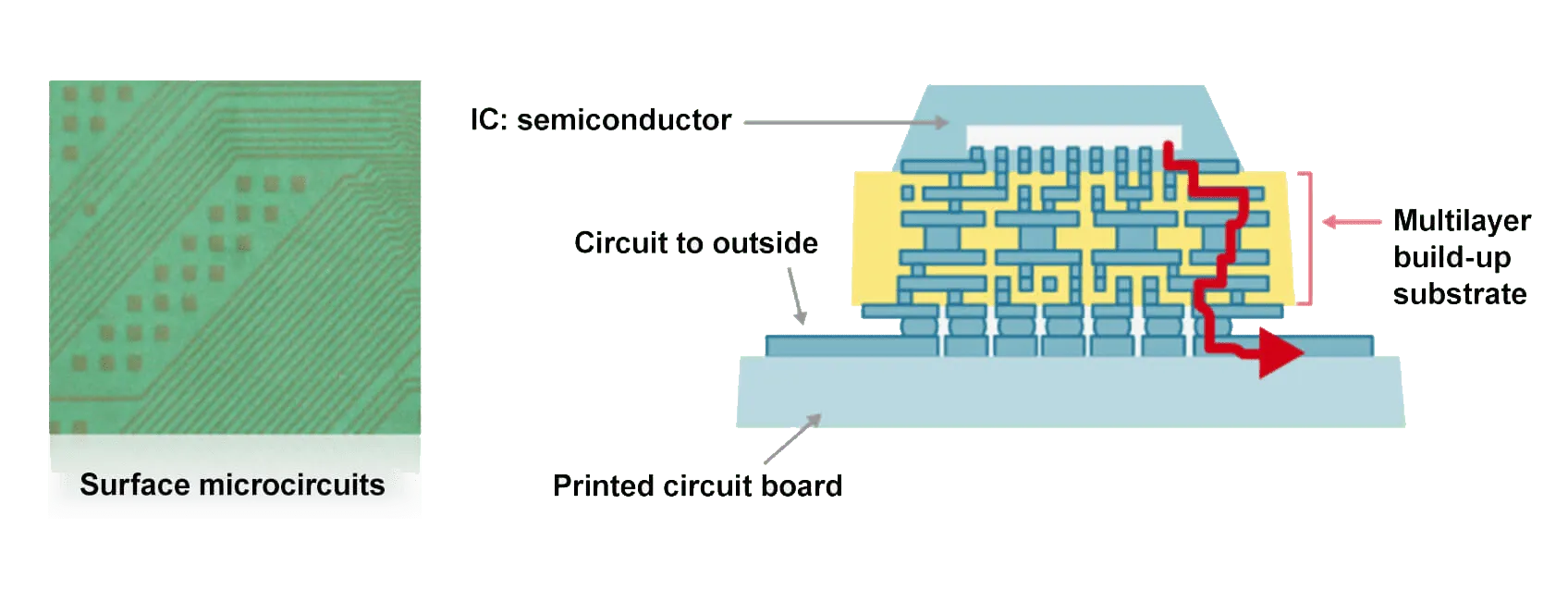
Ajinomoto’s illustration shows how a multilayer build-up substrate connects a chip’s terminals to external circuitry. ABF provides interlayer insulation in this type of substrate. Source: Ajinomoto, “Ajinomoto Build-up Film (ABF).”
Ajinomoto identifies several development challenges, including uniformly dispersing organic and inorganic components that do not readily mix, and adapting material properties and processing conditions to customer requirements. Heat resistance, copper plating, and laser processing all require ongoing testing. This suggests that replacing a material involves a whole set of process conditions: can the new material work with the manufacturing methods, produce circuitry that meets requirements, and maintain quality?
That helps explain why Taiwanese substrate makers must also secure upstream supplies when they expand capacity. Unimicron chairman SC Chien has discussed tight material supplies at a shareholders’ meeting and traveled to Japan to visit major suppliers. Substrate manufacturers still need materials to arrive on time for their prepared factories and equipment to be put to use.
Glass Fiber May Look Like Cloth, but Its Properties Determine Its Use
Nittobo’s specialty glass fibers serve different purposes. T-glass emphasizes low thermal expansion and a high elastic modulus, making it suitable for high-density package substrates. NE-glass and the more advanced NER emphasize low-dielectric properties for high-speed signal transmission. The former addresses dimensional stability; the latter addresses electrical performance and transmission loss.
Glass fiber suppliers therefore need to deliver material properties suited to a particular application, with consistency maintained through subsequent processing. Grouping every product under the same “high-end glass fiber” label obscures the different problems each is designed to solve.
Tetsuya Kawasaki, chairman of Nittobo’s Chiayi operation, has explained that temperature, humidity, and operators affect production conditions. Even with a set of conditions supplied from Japan, the Taiwanese plant still needs to make adjustments on site. The Chiayi plant has also sent groups of employees to Japan for training. These efforts bring materials expertise into volume production, turning a formulation into products that can be supplied consistently.
Seen this way, Taiwan’s reliance on Japan takes several concrete forms: buying products from Japanese materials suppliers, using their technology to manufacture in Taiwan, and processing Japanese yarn into specialty glass cloth through partnerships. Nan Ya’s arrangement with Nittobo expands Taiwan’s manufacturing capabilities while linking the two companies’ materials and processes more closely.
Western Buyers Need to Look Upstream of Taiwan’s Manufacturing
European and American technology companies obtain chips, substrates, and servers through Taiwanese supply chains. In doing so, they also draw indirectly on capabilities accumulated by Japanese materials suppliers. From Ajinomoto’s insulating film to Nittobo’s glass fiber, material properties influence downstream processing and product delivery.
This adds a practical question to supply chain management: when downstream manufacturers expand capacity, can the supply, specifications, and qualification of the corresponding materials keep pace? Nan Ya and Nittobo’s arrangement combines yarn supply with access to more weaving capacity, illustrating how production can be coordinated across companies and national borders.
Taiwan’s role in AI manufacturing needs to be understood within this broader supply network. Alongside TSMC and Taiwan’s electronics industry, buyers need to see the Japanese materials companies supporting the supply chains in which they operate.
Sources
- Wei Sheng-feng, “Japan’s Advanced Materials Stocks Become Hidden Champions,” Wealth Invest Weekly, issue 2426.
- Lin Yuan-qing, “Understanding the ABF Substrate Shortage,” Wealth Magazine, issue 771.
- “The Story of AI Glass Fiber Cloth in Taiwan’s Pineapple Fields,” Business Weekly, issue 2006, highlights edition.
- Nan Ya Plastics, “Nan Ya and Nittobo Form a Strategic Partnership in Specialty Glass Cloth to Meet Rapid Growth in AI Supply Chain Demand,” November 28, 2025.
- Ajinomoto Group, “Ajinomoto Build-up Film (ABF).”
- Nittobo, “Electronic Materials Business.”