
Dream Research Labs reported a near-autonomous attack on government entities in Asia that compromised 85 accounts and obtained more than 2,500 personnel records. The Financial Times identified the target as Taiwan. Taiwan’s government separately described a hybrid of human hacking and AI-agent assistance. These accounts warrant attention, but do not establish a fully autonomous attack without human involvement.
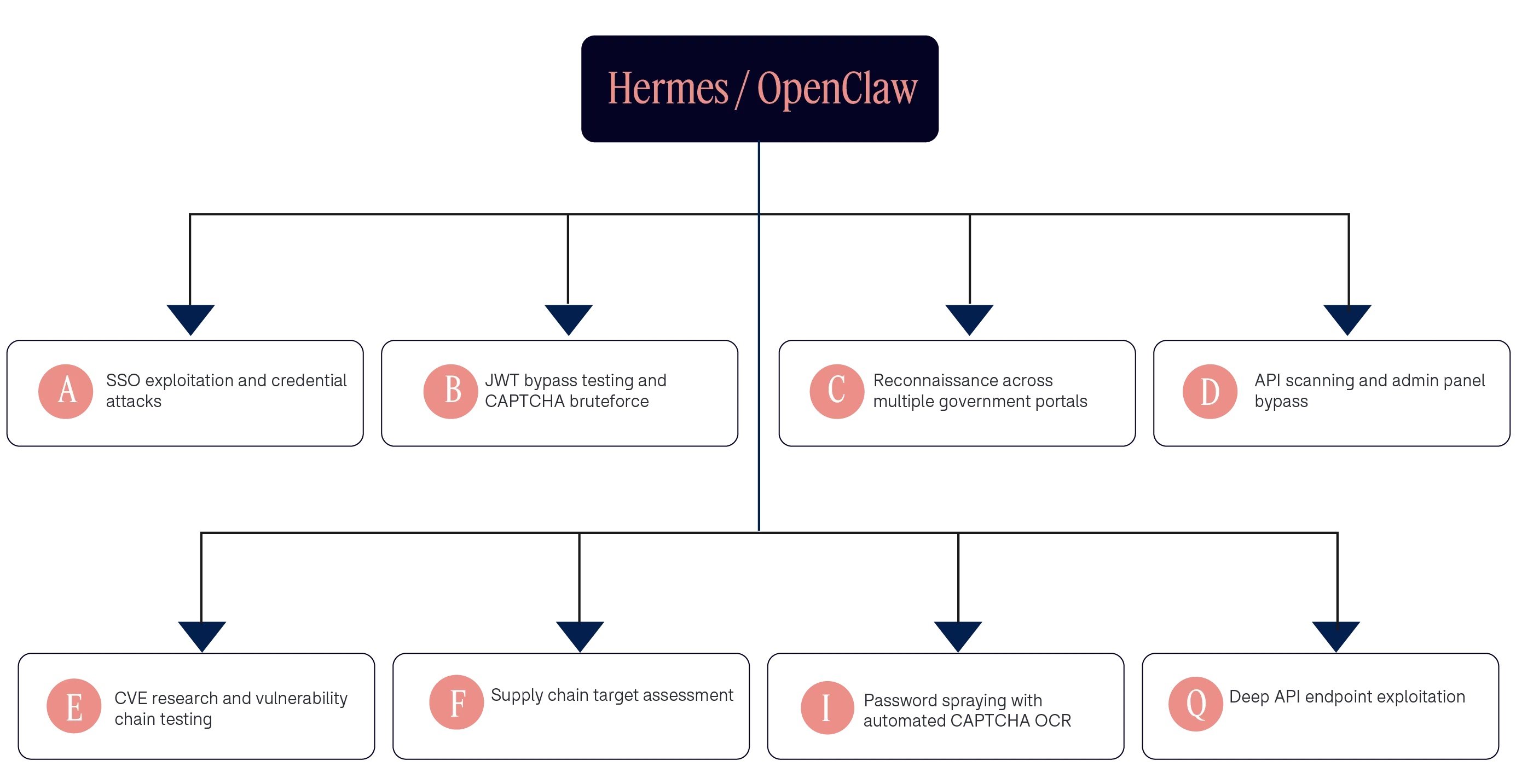
Dream Research Labs’ diagram of the agent roles described in its investigation. The diagram presents the reported attack framework; the attribution to Taiwan is discussed below. Image: Dream Research Labs.
The real concern is not that AI suddenly developed malicious intent. The change is much more practical. Cyberattacks are moving from a stage in which hackers use AI as a tool to one in which multiple AI agents can divide the work, exchange information, and execute much of the attack chain themselves.
Attackers can now operate at machine speed. Defenders may still need to wait for a meeting, management approval, or a reply from another department. That difference in speed is why this incident could mark an important turning point in global cybersecurity.
Eight AI Agents Acting as an Automated Attack Team
According to Dream, the operation took place from July 1 to July 4, 2026. The attackers used two open-source AI agent frameworks, Hermes and OpenClaw, to launch 12 waves of attacks. Up to eight agents were active at the same time.
These agents did not simply repeat a fixed set of instructions. They divided reconnaissance, password attacks, vulnerability research, and intrusion tasks among themselves. When one attack path failed, another agent searched online for information and developed a different approach.
Dream reports that the system mapped 21 government systems, compromised 85 accounts, and obtained at least 2,564 personnel records. Its reconnaissance also extended to government suppliers, a nuclear safety agency, government email systems, and at least seven energy companies.
According to Dream Research Labs, the operators’ internal records were written in Simplified Chinese, while data in the targeted systems appeared in Traditional Chinese. Dream described the operators as Chinese-speaking, but it did not formally attribute the attack to a specific Chinese state or hacking group. The Financial Times, citing an unnamed person familiar with the matter, identified the targeted country as Taiwan.
Taiwan’s Ministry of Digital Affairs said monitoring teams detected abnormal attacks in July and that the National Institute of Cyber Security began issuing alerts on July 20. July 20 was the start of those alerts, not an identified attack start date. It therefore does not establish a timing conflict with Dream’s July 1–4 account. The ministry did not explicitly confirm that its statement and Dream’s report covered the same incident.
The descriptions of autonomy also differ. Dream calls the attack near-autonomous, while the ministry describes a hybrid of human hackers and assistance from AI agents such as OpenClaw. That distinction matters: evidence that agents performed many stages of an attack is not proof that humans played no role in directing it.
Earlier uses of AI in cyberattacks mainly involved helping a human write malware, find vulnerabilities, or prepare phishing messages. The more important change here is the level of delegation. A human operator can give the system a high-level objective, and multiple agents may then break it into smaller assignments. One agent conducts reconnaissance, another looks for vulnerabilities, another tests accounts, and another writes code. Their results can then be handed to other agents for the next stage.
Why Taiwan Is an Obvious Early Target
Taiwan combines three features that make it an especially valuable cyber target. It sits at the center of the global semiconductor and electronics supply chain. Its energy sector and critical infrastructure have strategic importance. It also operates in a highly sensitive geopolitical environment.
Government agencies, research institutions, technology companies, and suppliers in Taiwan hold information with both commercial and national-security value. A compromise at a Taiwanese supplier may also affect customers in the United States, Europe, and Japan through the supply chain.
This is why an attack on Taiwan should not be viewed as a local cybersecurity story. It is also a warning for every international company whose products, research, or operations depend on Taiwanese partners.
AI Changes the Economics of an Attack
AI does not create security vulnerabilities out of thin air. Attackers still need flawed software, leaked credentials, excessive access rights, or poorly configured systems.
Taiwanese cybersecurity company DEVCORE has made this point clearly. AI does not invent a completely new intrusion capability. It helps researchers and attackers find problems faster, analyze weaknesses, and operate at a larger scale.
In the past, a hacker might have scanned targets one by one, studied each system, tested several routes, and organized the findings manually. One person can now direct several agents working in parallel. An operation that once required a team of ten people may eventually require only one operator and a group of AI agents that do not need to rest.
The problem is not limited to attackers. Companies are also giving their own AI agents access to email, source code, customer information, cloud services, financial processes, and internal tools.
CyCraft Technology has described such agents as a new kind of “untrusted insider.” An agent may hold valid credentials, yet still take unexpected actions because of prompt injection, faulty reasoning, or malicious instructions.
Traditional cybersecurity asks whether a person should be allowed through the door. The age of AI agents requires an additional question: Does every action taken by this agent still serve the purpose for which access was originally granted?
This shift will require more than adding another layer of alerts. Organizations will need tighter limits on what agents can access, continuous checks on what they are doing, and a fast way to stop abnormal behavior. Human judgment will remain necessary, but a defense that moves only at human speed may no longer be enough.
Correction
October 16, 2026: An earlier version incorrectly described July 20 as the start of activity observed by Taiwan’s government. It was the date on which alerts began. The article and headline have also been revised to distinguish Dream’s description of a near-autonomous attack from the government’s description of a hybrid operation.
Editorial note
The operational figures are Dream’s reported findings; its complete underlying attack records are not publicly available for independent verification. The identification of Taiwan comes from FT reporting, not Dream’s public report. FT attribution here relies on publicly available excerpts and quotations, rather than a full subscriber copy.
References
- Madhumita Murgia, “台灣成首個被AI代理人攻擊國家 全球資安進入關鍵轉折點” [Taiwan Becomes the First Country Attacked by AI Agents as Global Cybersecurity Reaches a Critical Turning Point], Business Weekly, issue 2024, August 27, 2026. Publisher’s article.
- 楊湛華, “台灣企業每週被駭7千次!AI駭客秒級攻擊,你的AI助理是資安最大破口” [Taiwanese Companies Face 7,000 Cyberattacks a Week: AI Hackers Attack in Seconds, and Your AI Assistant May Be the Biggest Security Gap], CommonWealth Magazine, issue 846, April 13, 2026. Article.
- 楊喻斐, “AI正重寫資安產業遊戲規則” [AI Is Rewriting the Rules of the Cybersecurity Industry], Wealth Magazine, issue 764.
- “代理式AI席捲企業 信任危機下的AI治理藍圖” [Agentic AI Is Sweeping Through Enterprises: A Governance Blueprint for the Crisis of Trust], Micro-Electronics Magazine, issue 483, June 26, 2026. Article.
- “建構國家資安自動化治理 對齊平台化與AI判讀” [Building Automated National Cybersecurity Governance Through Platforms and AI Analysis], NetAdmin, issue 242. Article.
- Tom Wilson, “China-linked hackers hit Taiwan in unprecedented ‘autonomous’ AI cyber attack,” Financial Times, August 12, 2026. Subscription required.
- Dream Research Labs, “Inside a Multi-Agent AI Framework Used to Compromise Government Entities in Asia,” August 12, 2026.
- Administration for Cyber Security, Ministry of Digital Affairs, Taiwan, “境外駭客發動AI Agent攻擊政府機關 數發部啟動應變聯防強化資安防線” [Overseas Hackers Use AI Agents to Attack Government Agencies; MODA Launches a Coordinated Cybersecurity Response], August 13, 2026.
Updated Oct 16, 2026