
As AI chips grow larger, the substrates beneath them are becoming a manufacturing challenge of their own.
Glass offers a flat, stable foundation. It also breaks. A material with promising properties is of limited commercial use if it cracks during drilling, cutting, or lamination.
Taiwan’s Ta Liang Technology has approached this problem by applying a special adhesive along the edges of the glass.
In an August 2026 interview, the company’s chairman said Intel had approached Ta Liang about three years earlier to address glass breakage during processing. Ta Liang worked with a Taiwanese chemical supplier for more than a year to refine the material and manufacturing process. It delivered fully automated lamination equipment at the end of 2025.
That thin layer of adhesive illustrates a business opportunity within AI hardware. Chipmakers can develop more ambitious designs, but equipment suppliers must make those designs practical to manufacture.
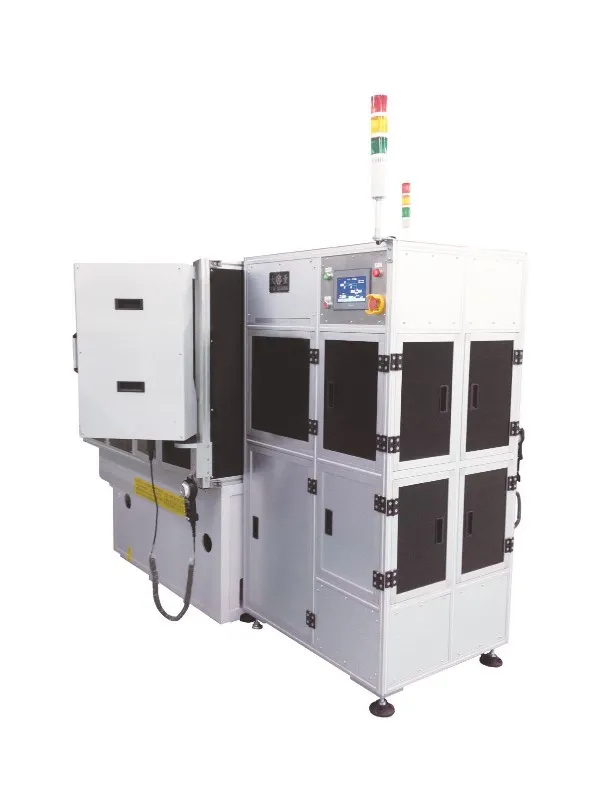
Ta Liang’s GEP1L / GEP1B automatic edge-coating equipment, featured in the 2017 Taiwan Excellence listing. This earlier panel-processing product illustrates the company’s coating-equipment background; it is not identified as the machine supplied for Intel’s glass-substrate project. Image: Ta Liang Technology / Taiwan Excellence.
Ta Liang’s coating experience predates the recent glass-substrate story. Its 2017 Taiwan Excellence product listing describes an automatic edge-coating machine for glass and plastic panels, with an in-house controller, edge measurement, and pre-curing. That listing documents an earlier equipment capability. The Intel collaboration and the end-2025 delivery remain claims attributed to the chairman’s magazine interview.
Glass and ABF Serve Different Purposes
A glass substrate does not mean replacing every existing material with glass.
Ajinomoto Build-up Film, or ABF, is an insulating film developed by Ajinomoto. It separates circuit layers in multilayer package substrates. A glass core provides structural support. Changing the core material does not, by itself, eliminate the need for ABF.
Intel’s interest in glass includes its mechanical stability, flatness, and potential to reduce thermal distortion. These properties become more valuable as packages grow larger and accommodate more chips.
The difficulty comes during processing. Laser drilling and cutting can leave microscopic cracks along glass edges. Stress from subsequent lamination and thermal processing can turn those small defects into fractures.
Ta Liang’s approach, as described by its chairman, involves precisely applying adhesive at the edges where the glass meets the ABF film, then curing it to provide protection. Getting the formulation right is only part of the work. The equipment must also apply an even coating, level the adhesive, avoid bubbles, and control curing speed.
A successful sample demonstrates that a method can work. A machine that repeatedly produces acceptable parts gives customers a reason to invest.
Ta Liang is selling the ability to bring those requirements together.
Backdrilling Is the More Immediate Business
Glass substrates offer a future opportunity. Ta Liang’s more immediate demand comes from high-end server printed circuit boards, or PCBs.
When high-speed signals travel through a plated hole in a circuit board, an unused conductive section can interfere with signal quality. Backdrilling removes that unwanted section while preserving the copper connections the circuit needs.
The challenge is that boards are not identical. As layer counts increase, variations in layer position and thickness after lamination become harder to ignore. Drilling too shallow leaves excess material. Drilling too deep can damage a connection.
Ta Liang’s TM inner-layer measurement equipment first collects position and depth information from inside the board. Its in-house controller and backdrilling machine then use that information during machining. The company also sells the measurement and drilling equipment together.
This capability took years to develop. Ta Liang previously relied on outside controllers, which limited its ability to respond when customers wanted changes. Developing its own controllers gave it greater control over how the machinery, software, and imaging systems work together.
For a board manufacturer, replacing a production system that already works reliably can involve more than comparing equipment prices. It may require validating process settings, quality, and throughput again. That creates an opportunity for equipment suppliers to build relationships that extend beyond a single machine sale.
Ta Liang’s chairman named Gold Circuit Electronics, Zhen Ding Technology Holding, and Unimicron among its customers. He also expected shipments of high-end backdrilling machines to exceed 1,000 units in 2026. That remains a forecast, but it shows where the company’s near-term business is concentrated: equipment upgrades for advanced PCBs.
Intel’s Glass Effort Involves More Than One Taiwanese Supplier
Protecting glass edges is only one part of the manufacturing process.
Group Up Industrial, another long-term participant in Intel’s glass-substrate development, has worked on thin-glass handling, lamination, coating, and heat treatment. Its lamination and annealing equipment has entered research and development lines, where the company has gained experience in handling fragile glass and maintaining process stability.
Ta Liang and Group Up Industrial address different problems. A large customer needs different capabilities at different production stages. Winning a place at one stage does not mean supplying the entire line.
Other Taiwanese companies are pursuing their own roles. E&R Engineering is working on laser drilling for through-glass vias, or TGVs. Scientech is involved in wet etching, while Skytech is developing electroplating for via filling.
Hua Yang Precision Machinery and Spirox are developing inspection capabilities for different stages of through-glass-via processing. HIWIN Technologies and HIWIN Mikrosystem provide precision-motion capabilities.
These activities do not necessarily mean that every supplier is already earning revenue from volume production.
After a hole is formed, it still needs metallization. Completed structures need dimensional and defect inspection. Every transfer between machines must avoid breaking the glass and wasting the work already done.
A weakness at any stage can hold back the whole line. Ta Liang’s ability to turn edge protection into further equipment orders therefore depends partly on the maturity of its customers’ other processes. Having a machine ready does not mean the entire market is ready.
The Real Test Is the Next Order
Ta Liang is not alone in high-end backdrilling. Germany’s Schmoll Maschinen also offers CCD alignment and Z-axis depth-control technology. Competition ultimately depends on whether a supplier can deliver accuracy, speed, and yield under a customer’s specific requirements for board materials, layer counts, and residual conductive stubs.
Glass-substrate equipment faces a similar test. Delivering the first machine is an important milestone. Repeat purchases and adoption by additional customers provide stronger evidence that the technology can support a durable business.
Customization also has a cost. It brings an equipment supplier closer to its customers, but it consumes engineering time. If every new order requires extensive redesign, revenue growth may not translate into comparable profit growth.
The economics can improve when accumulated process knowledge becomes reusable machine designs, control software, and operating parameters. The next order then benefits from work already completed.
Ta Liang is pursuing both opportunities: meeting current demand through integrated PCB measurement and backdrilling, while using its materials-processing and automation capabilities to enter glass-substrate manufacturing.
The significance of that adhesive is therefore larger than the glass it protects. An equipment supplier does not have to design the most prominent AI chip to become important to its production. Solving a manufacturing problem that customers cannot avoid may be enough to earn a lasting place in their supply chain.
References
The English translations of Chinese article titles below are provided for readers’ convenience.
-
林苑卿. 〈大量出奇招讓ABF和玻璃完美貼合〉 (“Ta Liang’s Unconventional Approach to Bonding ABF and Glass”). 財訊, issue 771, August 27, 2026.
-
Ajinomoto. “Ajinomoto Build-up Film.”
-
Intel. “Intel Unveils Industry-Leading Glass Substrates.” September 18, 2023.
-
黃冠豪. 〈半年報精選股出列〉 (“Stock Picks from Half-Year Earnings Reports”). 先探週刊, issue 2418, August 19, 2026.
-
鄧凱元、康瓊之. 〈大量獲利狂飆近5倍!黑手機械廠變身AI隱形冠軍 一技術「鑽」進先進封裝〉 (“Ta Liang’s Profits Surge Nearly Fivefold: A Machinery Maker Becomes an AI Hidden Champion and Drills Its Way into Advanced Packaging”). 天下雜誌, issue 850, June 2, 2026.
-
林苑卿. 〈英特爾一句話 群翊練兵10年磨出玻璃基板真功夫〉 (“An Intel Request Sets Group Up Industrial on a Decade of Glass-Substrate Development”). 財訊, issue 768, July 16, 2026.
-
尚清林. 〈玻璃基板崛起 台廠受惠「圓轉方」封裝革命大商機〉 (“Glass Substrates Rise: Taiwanese Suppliers Look to Opportunities in the Shift from Round to Square Packaging Formats”). 財訊, issue 768, July 16, 2026.
-
Schmoll Maschinen. “Schmoll: Unrivaled Precision in Back Drilling Technology.” June 6, 2025.
Updated Oct 16, 2026