
Nytex once faced a hurdle before it could begin developing advanced semiconductor materials: obtaining the raw materials. Jason Chen, chairman of the Taiwanese polymer compounder, recalls that Intel’s early manufacturing needs drove US and European materials companies to develop higher-performance materials. Some of those suppliers controlled both raw-material production and compounding, and did not sell the raw materials to outside companies. Other compounders struggled to enter the market, even if they had the processing capabilities.
Jason Chen attributes Nytex’s eventual access to those materials to its customer relationships and responsiveness in Taiwan. Operating close to semiconductor companies such as wafer-carrier maker Gudeng, Nytex could respond more quickly on deliveries, processing, product adjustments and troubleshooting. Upstream suppliers became willing to provide raw materials while Nytex handled formulation development and processing near the customer. Work previously concentrated within overseas materials companies could then be divided differently.
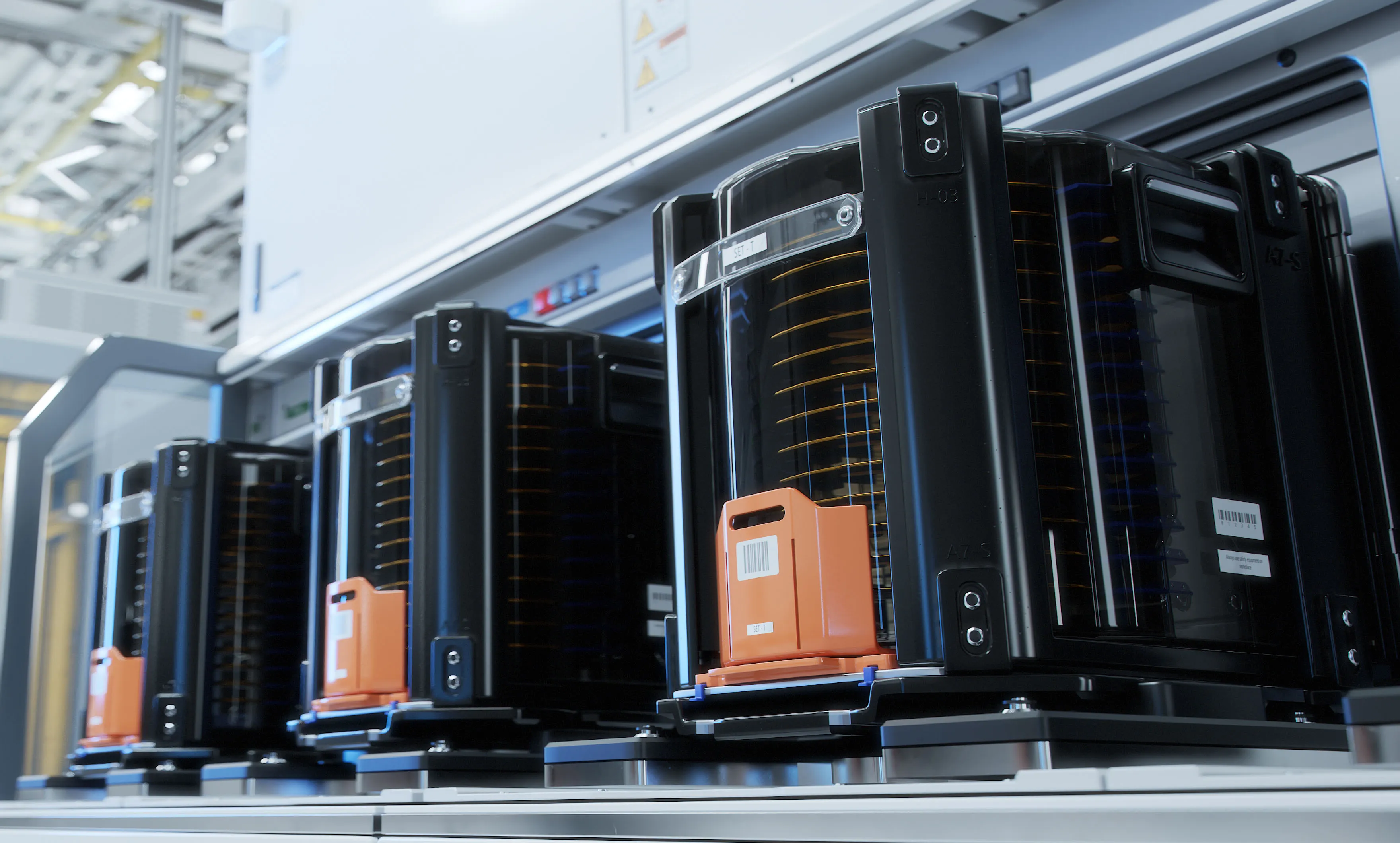
A wafer-carrier application shown on Nytex’s website. Carrier materials must meet requirements for cleanliness, antistatic performance and dimensional stability. Image: Nytex, Specialty Compound.
Taiwanese Customers Offered Suppliers a Different Way to Cooperate
Jason Chen points to large materials companies such as DuPont when describing how patents and supply for certain specialty materials were once concentrated among a few suppliers. The high-performance compounds Nytex made in the past were at a different level from the materials needed in semiconductor applications today. Only in the past seven to eight years, he says, did semiconductor opportunities give the company access to higher-end raw materials.
Gudeng also includes introductions to raw-material suppliers in its support for local manufacturers. Its supply-chain management disclosures identify gaps in semiconductor knowledge and specialty raw-material sourcing among high-performance compounders. Gudeng provides relevant knowledge, helps establish dedicated production lines and introduces raw-material suppliers, creating a three-way partnership. Nytex’s local responsiveness could become useful when combined with customer demand and access to materials.
Gudeng’s Search for New Materials Gave Nytex a Chance to Qualify
Gudeng had a reason to seek alternative materials. Speaking on the Statementdog podcast, Jason Chen said Gudeng had faced supply pressure during a dispute with competitor Entegris. In his account, Entegris had asked suppliers not to provide materials to Gudeng. Gudeng therefore had an incentive to find a new source, while Nytex had an opportunity to move from materials for office furniture and power tools into semiconductors.
The collaboration began with a conversation between Jason Chen and Gudeng chairman Ming-Chien Chiu at a social gathering. After learning that Nytex worked with materials, Chiu visited its factory the following week with five executives. He saw a basis for cooperation in its management and equipment, then set out the requirements for semiconductor materials.
To meet the cleanliness requirements of semiconductor end customers, Jason Chen says, Nytex invested nearly NT$60 million in factory improvements and new equipment before it had any orders. General manager Yuhan Chen recalls that establishing the clean production area and buying new equipment took about seven to eight months. Developing the first material grade then took roughly another seven months.
Gudeng’s willingness to share test data showed Nytex which direction to take when adjusting the formulation. Receiving only a failed result, without knowing where the problem lay, would have made it difficult to accelerate development.
Yuhan Chen notes that carriers and their materials account for only a small share of total manufacturing-process costs. As long as the existing material performs consistently, end customers are often reluctant to take the risk of switching. Gudeng’s actual need for materials, together with its willingness to invest in qualification, gave Nytex continuing feedback with which to refine its formulations.
The Base Polymer Is Easier to Identify Than the Mixing Ratios
Once the raw materials are available, how is the formulation developed? Yuhan Chen says Nytex can obtain competitors’ samples and analyze their base polymers in its laboratory, with part of the work resembling reverse engineering. Identifying the base materials, however, does not make the proportions of the ingredients easy to determine. Those still require experimentation.
Jason Chen gives the example of a customer simultaneously requiring antistatic performance, low volatile organic compound (VOC) levels, high cleanliness, heat resistance and dimensional stability, all at an acceptable cost. If the material must withstand 130°C or 150°C, Nytex first screens raw materials that can meet that requirement, then adjusts the other properties. Knowing which materials companies such as Intel already use can also help narrow the development work.
Carbon nanotubes or carbon fiber can be added to adjust antistatic properties, Yuhan Chen explains, but the customer still has to injection-mold the material. Semiconductor carriers and IC trays require uniform electrostatic properties. Adjusting antistatic performance can also change dimensional stability and cause problems such as warpage. The formulation ultimately has to deliver the required results after the customer’s processing. Knowing the ingredients does not eliminate that cycle of adjustment.
Larger carriers bring further formulation work. Yuhan Chen says Nytex is working with Gudeng on materials for advanced-packaging carriers, with some projects still undergoing qualification. Larger carriers use more material per unit and must support greater loads and meet higher strength requirements. Dimensional stability and antistatic requirements remain, so the formulation needs further optimization.
BBU Materials Grew Out of a Project That Never Led to a Deal
Nytex’s materials business for battery backup units (BBUs) grew out of earlier thermally conductive formulations. Yuhan Chen says the company began developing thermally conductive materials about a decade ago. A foreign company later asked whether it could add protection against fire propagation. Nytex initially did not know what the customer had in mind; only later did it understand that the application involved battery packs.
The two companies never entered an actual commercial collaboration, but the work gave Nytex a new direction. It began looking for relevant customers in Taiwan. Its existing formulations continued to evolve into the materials it later supplied for BBUs.
According to Yuhan Chen, these materials conduct heat and spread it more evenly during normal operation, helping cells dissipate heat. When a cell goes into thermal runaway and exposes the material to flames, it forms a char layer intended to limit fire spreading to other cells. The two functions address normal operation and an accident, respectively.
To demonstrate the effect to customers, Nytex brought in specialists to help design small battery packs using its materials. It sent the packs to a third-party laboratory for fire-propagation testing and recorded the process on video to show customers. Yuhan Chen recalls that, in the first year of this effort, the company conducted 30 to 40 tests on its own, excluding tests carried out jointly with customers.
Customers can also take other approaches. Yuhan Chen says some manufacturers use different materials together with structures such as metal mesh or fire-resistant sheets. Nytex needs pack-level testing to show customers how its materials perform within an actual design.
Taking Semiconductor PEEK Experience into Robot Joints
Jason Chen says Nytex has used substantial amounts of PEEK, or polyetheretherketone, in semiconductor applications. Its familiarity with sourcing and processing the material has therefore also led it to consider opportunities in robotics.
Yuhan Chen says the main target is robot-joint components, where PEEK reinforced with carbon fiber could replace some metal parts while providing stiffness, lower weight and wear resistance. Jason Chen adds that robots need battery power to keep moving. Structural weight increases the load on their drives, giving weight reduction a practical value.
One important question remains unresolved. Long-term reliability testing is still underway, Yuhan Chen says, and it is not yet clear how PEEK compounds will perform relative to metal. Nytex already has semiconductor-materials experience, but service life under the repeated motion of robot joints still needs separate validation.
Sources
- Statementdog, “Episode 572: The Key Materials Supplier Chosen for Advanced Semiconductor Processes and BBUs, Featuring Nytex Chairman Jason Chen and General Manager Yuhan Chen,” October 28, 2026.
- Louis Hou, “Building a Taiwanese Science Park in America, Part 3—Alliances: Gudeng Leads 18 Veteran Entrepreneurs in a Fight to Survive,” Business Weekly, Issue 1972.
- Gudeng Precision, “Sustainable Supply Chain.”
- Nytex, “Specialty Compound.”
- Nytex, “Flame-retardant Material.”