
Installing a more powerful AI processor in existing military equipment raises a practical problem: the enclosure has not grown, and neither has the space available for power delivery and heat removal. New recognition, tracking, and data processing functions must draw power from the same equipment, which must also dissipate the heat they generate. Processor performance is only one part of the upgrade. Whether the platform can operate continuously also depends on its power and cooling systems.
Ron Gaw, president of Aegis Power Systems, notes that military platforms require more power as they take on AI target recognition, tracking, and real-time intelligence processing.
More Computing Power in the Same Enclosure
Vicor’s Matt Renola notes that some equipment retains the same physical dimensions while its power requirements increase. Such upgrades extend the challenge beyond processor selection to the entire platform: how can the power system deliver more power within the existing space, and how will the heat generated during conversion be removed?
High Efficiency Still Requires Heat Removal
A conversion efficiency of 96.5% may look high, but at sufficiently high power levels, the remaining losses still create a cooling burden. Suppose a converter delivers 1,000 watts to its load at 96.5% efficiency. Its input power would be approximately 1,036 watts, leaving a difference of about 36 watts.
In this example, the approximately 36 watts represents the converter’s power loss. Heat generated by the processor and other loads must be counted separately. Estimating the cooling requirements of the complete system therefore requires accounting for both conversion losses and heat generated by the loads themselves.
For equipment housed in sealed enclosures, the lack of airflow makes heat removal more difficult. Higher efficiency can reduce conversion losses, but it cannot replace a design that conducts heat out of the enclosure. An efficiency percentage alone is insufficient to determine cooling requirements. How much power the equipment can deliver continuously in a particular environment still depends on its actual thermal conditions.
Computing Moves Onto the Platform, and Power Demand Follows
Vicor’s Scott Lee notes that limited communication between platforms is driving more processing capability, particularly AI processing, onto individual platforms. As work previously handled by other nodes moves onto the equipment itself, local power delivery and thermal management must support the additional load.
A DigiKey technical marketing engineer notes that engineers deploying single-board computers (SBCs) in edge AI systems face constraints involving memory, cooling space, and cost. An SBC integrates the main computing components onto a single board, helping industrial edge equipment become more compact. Space outside the board is still needed for power delivery, cooling, and other components.
Distributed deployment and modular power systems address different levels of the problem. Distributing troops or equipment requires coordinating missions and energy supplies across platforms. Modular power systems inside an enclosure focus on conversion and integration within a single piece of equipment. Even after the internal module design is complete, energy distribution between platforms still requires separate arrangements.
New Components Create Design Opportunities, but System Integration Remains Essential
Matt Renola says that the aerospace and defense market is using wide-bandgap power devices, including gallium nitride (GaN) and silicon carbide (SiC), to increase power density and reduce conduction and switching losses. For existing platforms, these improvements can create room for additional computing functions.
Texas Instruments (TI) notes that GaN’s conduction and switching loss characteristics can support higher switching frequencies while keeping losses under control, allowing some passive components to become smaller. Once component sizes are reduced, the complete system must still address load-generated heat, cooling, and packaging before those device advantages translate into usable space.
ROHM notes that realizing GaN’s high-speed switching capabilities requires compatible gate drivers and controllers. Adoption also requires consideration of cost, reliability, and application feasibility. Changing semiconductor materials is only one part of power system design; surrounding circuitry and integration conditions also matter.
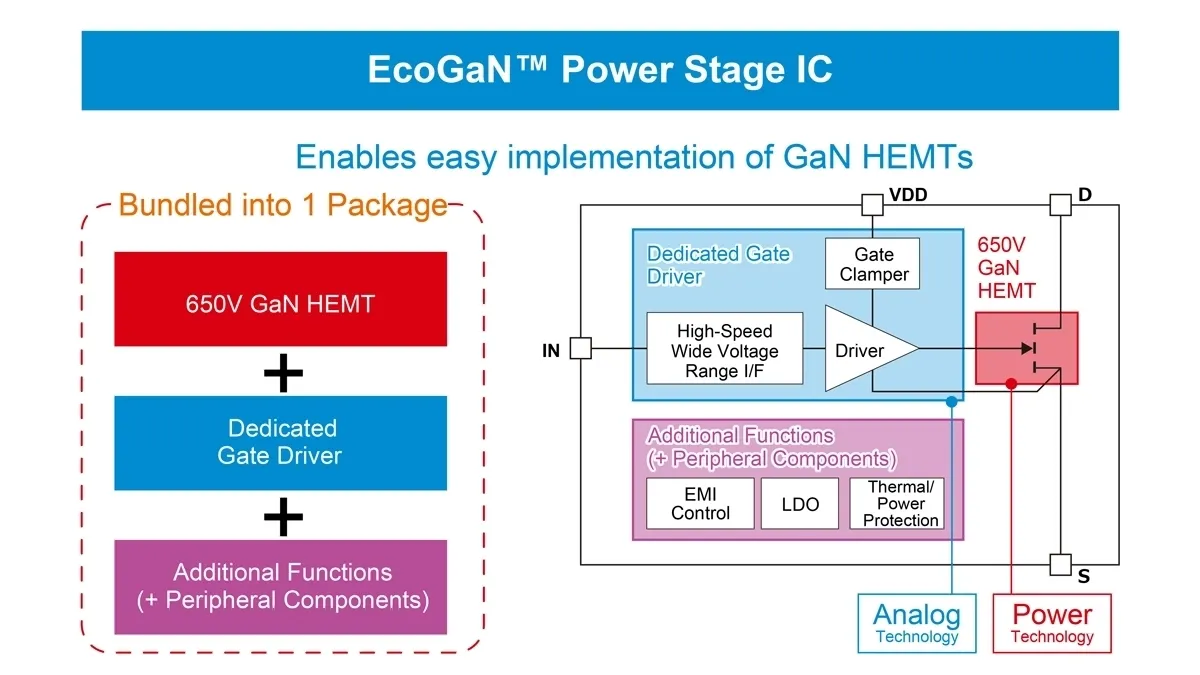
A GaN power stage integrates the power transistor, gate driver, and protection functions. Source: ROHM, figure 4 in 新通訊, issue 301, “Small Size, High Power, and Low Losses: GaN Devices Advance Into Power Applications.”
Assessing the Upgrade at Platform Level
Ron Gaw believes that future power systems must report operating status in real time, provide backup capability, and rapidly route power to critical loads as needed. These capabilities broaden the evaluation from how much power a system can deliver to how it responds to an interruption and whether power can reach the required location in time.
EDATEC uses supercapacitors to provide power-loss protection, giving industrial SBCs time to shut down properly and reducing the risk of damage to data or storage devices. A safe shutdown and uninterrupted mission operation require different backup capabilities. When evaluating military platforms, the first step is to establish what must be preserved after a power interruption: data, equipment state, or the mission in progress.
A useful platform specification would connect four quantities: sustained load power, conversion loss at that load, the available heat-removal path, and the duration and purpose of backup power. Peak efficiency and rated power quoted under different conditions cannot supply that picture.
For this kind of upgrade, I would give more weight to a sustained-operation test with a stated enclosure, ambient temperature, and cooling arrangement than to a higher headline processor rating. That is a testable engineering criterion, rather than a claim that any particular vendor has already met it.
Editorial note
This analysis draws on published supplier contributions from Vicor, DigiKey and ROHM. Statements by industry representatives are attributed to those publications.
References
- New Communications (新通訊), “Military Power Demand Rises as System Design Moves Toward Greater Efficiency and Decentralization.” Contribution by Vicor’s Taiwan general manager.
- Micro-Electronics Magazine (新電子), “Reliability and Flexibility Become Critical as Industrial SBCs Accelerate Edge Computing,” issue 487, October 2026. Contribution by a DigiKey technical marketing engineer.
- New Communications (新通訊), “Small Size, High Power, and Low Losses: GaN Devices Advance Into Power Applications,” issue 301, March 2026. Contribution by ROHM.
Updated Oct 16, 2026