
Once an AI server is connected to a liquid cooling loop, heat begins to flow away from its chips. But installation and maintenance challenges are only beginning. How pressure changes with temperature, where metal debris accumulates, and what takes over when equipment fails all affect whether a data center can keep running. For a liquid cooling supplier, delivery may extend well beyond shipping equipment from the factory.
Taiwan’s Meta Green Cooling (MGC) is building its business around this work. Founded in 2022, the company reported approximately NT$970 million in revenue for the first half of 2026. It supplies coolant distribution units and also integrates and installs data center cooling systems. Its listed customers include Wistron, Realtek and Global Unichip (GUC). The young company’s entry point is bringing equipment, piping, controls and on-site engineering together into a system it can deliver to the customer.
One Leak Exposes a System-Wide Problem
MGC President Clyde Chu recalls an early liquid cooling installation in which the team needed repeated inspections to identify the cause of a leak: liquid expanding as it warmed inside a closed loop, raising the pressure. The solutions included adding an expansion tank, monitoring temperature, pressure and flow, and arranging for backup equipment to take over when coolant delivery fell short.
Replacing a single component rarely resolves this kind of failure. The system design must allow for pressure changes, the controls must detect abnormalities promptly, and backup equipment must be ready to operate when needed. Even if each part works individually, engineers still have to establish how the parts respond together. The installation team’s accumulated value includes identifying where a failure originates and whether a repair will create a problem elsewhere.
This field experience grew out of MGC Chairman James Chen’s long career as an entrepreneur and executive in thermal management. In 1994, he founded Huashi, moving from distribution into CPU coolers and mounting clips. The business was later acquired by the US company Aavid, where he became Asia-Pacific president. In 2001, he founded Youju to make heat pipes and other thermal components. After the US company Vette acquired Youju in 2004, Chen served as Vette’s Asia president, while Chu was its chief technology officer.
At Vette, their work expanded from cooling electronic products to complete liquid cooling systems. As the company moved into liquid cooling technology used in IBM supercomputers, its Asian team took responsibility for system design and installation. Chen and Chu led engineers into university laboratories in different countries and the computing facilities of Taiwan’s Central Weather Bureau. They connected coolant piping and equipment, installed control software, and dealt with problems that emerged during operation. The leak, pressure monitoring and backup arrangements described above were part of that field experience.
After leaving Vette, Chen also joined Kenmec as general manager of its thermal division, leading a team that developed CDUs, liquid-cooled rear doors and liquid cooling components. His work continued to focus on liquid cooling product lines and the equipment needed to make them work as a system, before he founded MGC in 2022.
From CPU coolers and heat pipes to liquid cooling equipment and data center installation, Chen accumulated experience spanning components and on-site engineering. This helps explain why MGC could take on work beyond individual pieces of equipment early in its life. The company was young, but its core team had already dealt with the practical problems that arise when equipment is connected to different data centers.
The CDU Connects Chip Cooling Loops to Facility Infrastructure
A coolant distribution unit (CDU) sits at a critical interface in a liquid cooling system. In a liquid-to-liquid architecture, a heat exchanger transfers heat from the server-side coolant to the facility-side water loop while keeping the two fluids separate and regulating coolant supply conditions. Cold plates remove heat close to the chips; the CDU manages how that loop works with the facility’s cooling infrastructure.
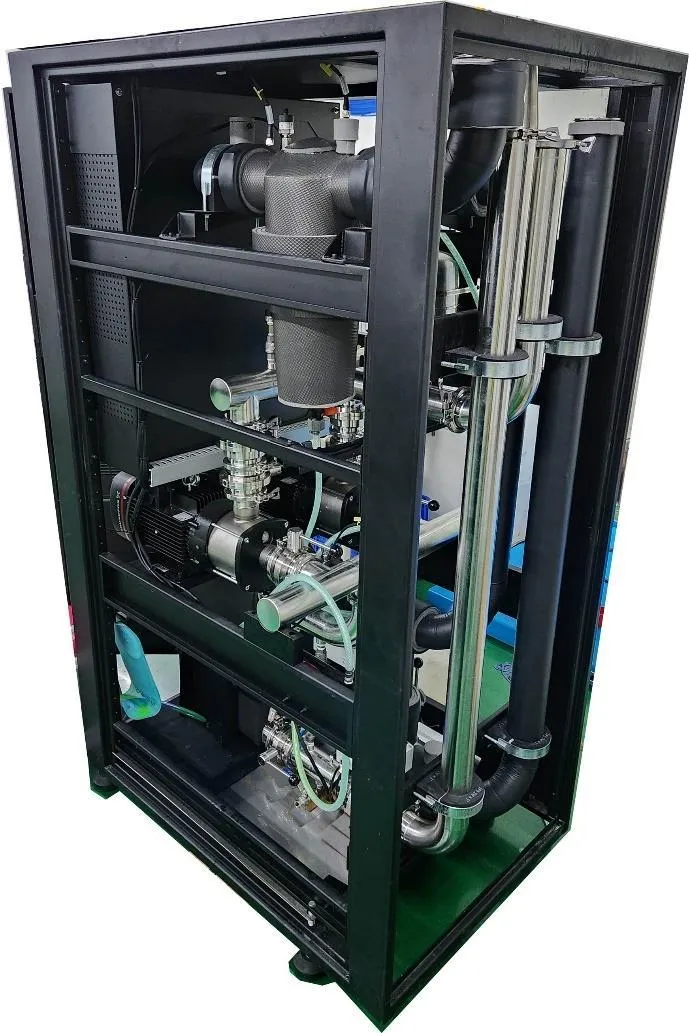
Figure 1. An example of the internal assembly of an in-row CDU. Source: Berhanu Wondimu et al., OCP, Liquid to Liquid CDU Test Methodology and Performance Rating, Revision 1.0, p. 12, original Figure 4. Image unchanged, used under CC BY-SA 4.0. Original document.
Chen says MGC initially made cold plates for ASUS motherboards. But with cold plates positioned close to expensive chips, the potential losses from a leak led the company to shift its focus to CDUs, which the team already knew well. The decision illustrates how a startup weighs its technical experience against the risks it can afford to carry. Moving into CDUs and system integration meant managing more connections and operating conditions between the cooling equipment and the customer’s site.
Materials and cleanliness can also change the scope of the work. Chen notes that customers have requested replacements for materials that could shed particles. Metal debris flushed out of cold plates can also accumulate along the piping, prompting MGC to develop filtration equipment. Once a problem moves with the coolant across equipment boundaries, the integrator needs to understand upstream components, the circulation loop and downstream loads. The value of a filter also depends on where it sits in the overall system and how it is maintained.
Wistron Brings Engineering Work Beyond the Equipment
Retrofitting existing data centers gave MGC another early opening. Chen recalls that when he first proposed liquid cooling to Realtek, the initial obstacle was the customer’s concern about bringing water into the server room. A retrofit must fit existing spaces and piping, and users need to accept a new way of operating the facility. Explaining equipment performance is only part of the job; site constraints and customer concerns also have to be addressed.
As projects increased, MGC’s work extended into data center water, electrical and network infrastructure, as well as coolant piping within racks. Chu compares turnkey construction to renovating a building: different trades need access to the site, and getting the sequence wrong can mean tearing out completed work and starting again. Customers are therefore buying construction coordination, problem-solving and responsibility for delivery. The staffing and judgment these tasks require are difficult to capture fully on a product specification sheet.
Wistron has played the roles of both investor and customer. MGC’s corporate history records Wistron’s investment in 2024 and lists Wistron and its US subsidiary WisLab among subsequent customers for data center infrastructure. Wealth Magazine also describes their collaboration on liquid cooling equipment and data center engineering. When server manufacturers need testing and production environments, a supplier’s work extends beyond the equipment itself into the layout of production lines and facilities.
MGC’s publicly described relationship with NVIDIA centers on product certification. MGC says its 1.3 MW TC1288 liquid-to-liquid CDU received NVIDIA certification in 2026. For a supplier, meeting platform requirements and deploying equipment at a customer’s site are successive tasks. The first makes a product eligible for use in the relevant systems; the second still requires work on each site’s piping, controls and construction arrangements.
Large Suppliers Are Also Competing for the Whole Data Center
MGC’s competitors are expanding their services too. Daniel Chang, Delta’s general manager of Taiwan sales, says AI data center planning must address power supply and distribution, liquid cooling, floor loading, fire protection, environmental sensing, and operations and maintenance together. Delta’s turnkey services cover design, procurement, construction, testing, acceptance, handover and maintenance. Large suppliers already have an incentive to take on these stages as a package.
Equipment comparisons are also becoming more systematic. The Open Compute Project’s CDU testing and performance document evaluates cooling capacity in relation to conditions such as water temperature, flow and pressure. Its co-authors include Chu and engineers from Intel and CoolIT Systems. As the industry develops common methods of comparison, MGC needs to translate its familiarity with equipment into successful delivery across different sites.
For MGC, the test of growth will lie in people and processes. More projects require more engineers who can diagnose site problems, as well as ways to turn senior staff’s experience into installation, testing and maintenance procedures. If orders grow faster than delivery capacity, the integration services that attract customers will also bring schedule and coordination pressures that the company must carry itself.
Sources
- Zhang Ruxian, “How a Four-Year-Old Cooling Startup Entered the Data Centers of Wistron and NVIDIA,” Business Weekly, issue 2031, pp. 54–56.
- You Xiaoyan, “Meta Green Cooling Improves Cooling Efficiency and Drives an AI Data Center Revolution,” Wealth Magazine, issue 761.
- Tang Ziqing, “Intel Certification Makes It Asia’s Only Partner: How Kenmec Is Winning Business from Major US Companies,” Mirror Media.
- “Turnkey Engineering Integrates High-Density Data Centers and Reduces Conversion Losses from Grid to Chip,” NetAdmin, issue 247.
- Meta Green Cooling, “About Us” and “Financial Information.”
- Berhanu Wondimu, Edward Kung, David Zhou, Brad Zakaib and Clyde Chu, “Liquid to Liquid CDU Test Methodology and Performance Rating,” Open Compute Project, Revision 1.0, pp. 1–2, 5, 11–20.