
AI data centers need more power. For power supply makers, that does not necessarily mean selling more of the products they already make. As NVIDIA changes how electricity reaches the rack, suppliers face a fresh question: which part of the next system will still depend on their technology?
That helps explain Taiwanese power supply maker LITEON’s move to acquire Nenglixin. LITEON has already earned a place in the AI supply chain through its advanced server power supplies. It is now turning to a team led by University of Cambridge professor Teng Long to add capabilities. The market for AI infrastructure keeps expanding, yet established products may find their place in the system changing. Growth from existing customers and the technical demands of the next architecture are testing the supplier at the same time.
Higher Voltage Moves the Work of Power Conversion
Conventional data centers deliver alternating current, or AC, to the rack, where power supplies convert it to direct current, or DC, before further stages reduce the voltage to what processors need. As more GPUs fit into each rack, low-voltage distribution has to carry more current. Busbars, cables and power equipment begin to consume more space.
NVIDIA’s push for 800V DC distribution aims to change that path. In a native DC facility, AC-to-DC conversion is centralized at the facility level, and high-voltage DC is then delivered to the compute racks. This can remove some conversion stages and reduce the current needed to carry the same amount of power. NVIDIA’s architecture description explicitly retains DC-to-DC conversion inside the rack.
That division of work matters. GPUs do not run directly on 800V. High voltage helps deliver electricity, but the voltage still has to fall as it gets closer to the chips. For suppliers, the question expands from how much power a unit can deliver to whether they can manage voltage, size, cooling and control together at a different point in the conversion chain.
Rising demand for electricity and continued demand for a particular type of power supply are therefore separate questions. An architectural change can consolidate some functions while raising the technical demands on others.
LITEON Is Trying to Shorten the Time Needed to Build New Capabilities
LITEON is not starting from scratch. In interviews with CommonWealth Magazine in 2023, the company described how it had pursued advanced AI server power supply business through custom designs, transformer development and load testing. That engineering experience helps explain how it became an established supplier.
But experience with AC-to-DC products does not automatically provide every capability needed to step down high-voltage DC. LITEON executive Yangbo Weng estimated that developing the required DC-to-DC technology internally could take four to five years. The company therefore looked outside for a team.
In June 2026, LITEON’s board approved a framework agreement to acquire all the equity in Nanjing Nenglixin. The company’s R&D is connected to the Cambridge team, and founder Teng Long’s research spans power conversion, packaging and control. The logic is to connect new conversion technology with LITEON’s existing product development and customer relationships.
Those four to five years also have to fit within customers’ platform design schedules. While a supplier develops its technology, customers are deciding the architecture of their next systems. A product that arrives too late may miss the opportunity to participate in early design and validation, even if it eventually works. Acquiring a team offers a shorter route to building that capability; integration still has to preserve the time gained.
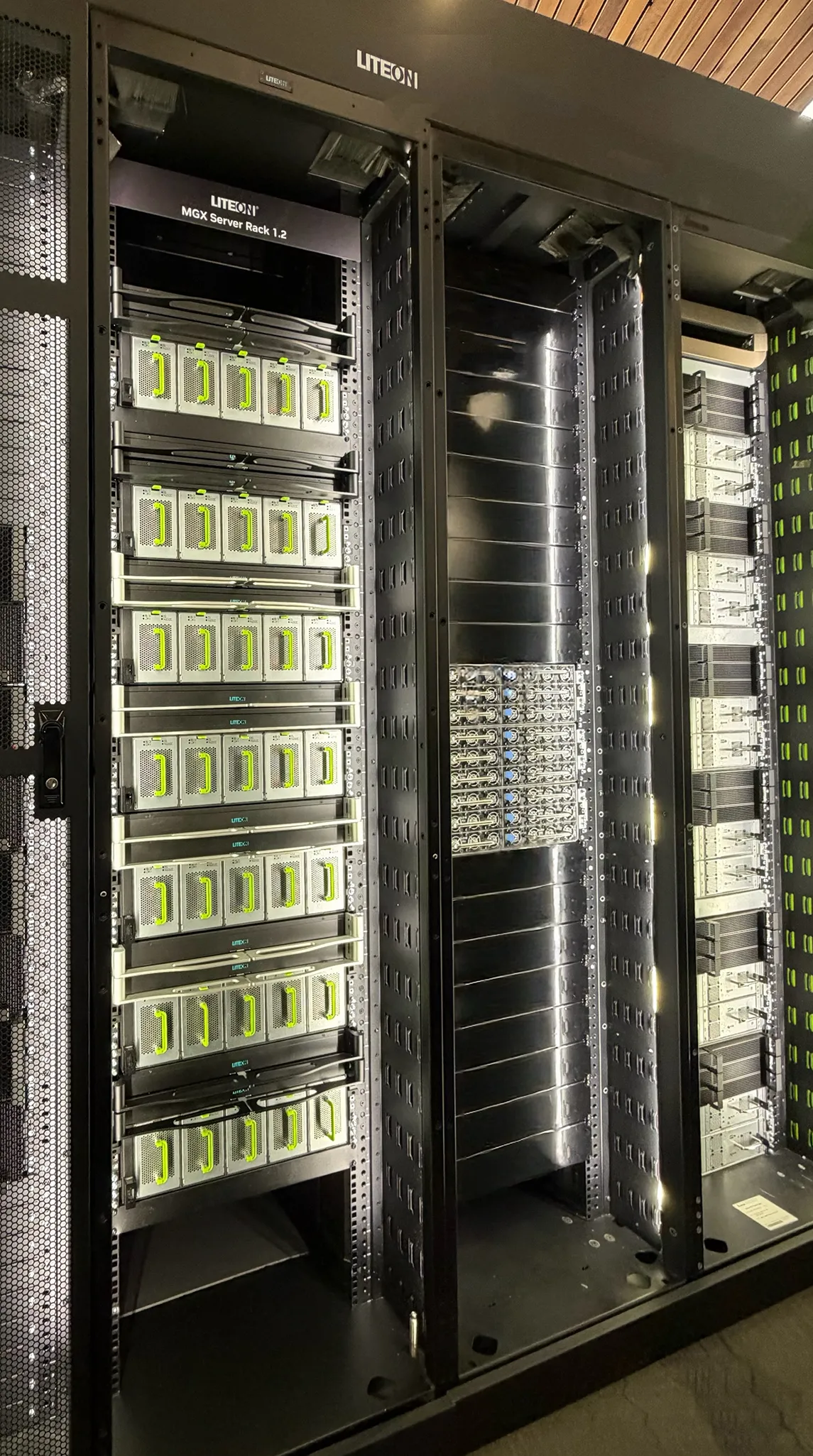
LITEON’s rack display at the 2026 OCP Global Summit. Image: LITEON.
Supporting Old and New Architectures Broadens the Engineering Burden
The transition to 800V will not happen in every data center at once. NVIDIA’s 2026 roadmap includes a hybrid architecture that retains existing AC infrastructure and supplies 800V through power racks, alongside centralized conversion for new facilities. Analog Devices (ADI) also notes that the mature 48V ecosystem continues to serve needs for cost, compatibility and reliability.
That creates a harder resource allocation problem for LITEON. Its existing AC-to-DC products still need improvements in efficiency, reliability and delivery, while the company also invests in the next generation of DC-to-DC technology. Customers can migrate in stages. Suppliers have to prepare several product paths ahead of them.
The value of the acquisition therefore cannot be judged simply by counting the product models it brings in. Can the new team’s designs enter platforms that customers are developing now? Can the conversion modules pass validation under actual load, cooling and protection requirements? And can LITEON turn those designs into products it can supply reliably?
800V Changes Who Can Help Design the Next System
For data center operators in Europe and North America, changes at suppliers such as LITEON offer a way to understand competition in AI hardware. As GPU roadmaps advance, power distribution, conversion and protection equipment also need redesigning. Supplier relationships increasingly involve system problems that customers and vendors must solve together.
Adding DC-to-DC capabilities gives LITEON a chance to carry existing customer relationships into the design of the next generation of systems. Its experience delivering advanced power supplies still needs to be combined with new conversion technology to meet changing customer requirements. Whether this move produces sustained business will depend on how well joint development, validation and volume production connect.
The 800V challenge is arriving while demand for LITEON’s existing business is still growing. The company has to use the resources it is accumulating today to build the capabilities its customers’ next platforms will require.
Sources
- Mengxuan Yang, “A Full Professor at Cambridge at 36: Who Is Teng Long, LITEON’s New Asset in Following NVIDIA’s Shift to 800V?” CommonWealth Magazine. Article
- Mengxuan Yang, “ChatGPT’s Exclusive Power Supplier: How LITEON Moved from Low-Cost Products to the High End and Surpassed the Market Leader in Performance.” CommonWealth Magazine, issue 770. Article
- “800V Architecture Reshapes Data Center Power as AI Racks Enter the Megawatt Era.” Micro-electronics, issue 483. Article
- NVIDIA, “NVIDIA 800 VDC Architecture Will Power the Next Generation of AI Factories,” May 20, 2025. Technical article
- Harry Petty, “Why Scaling AI Compute Performance Requires a New Power Architecture,” NVIDIA, August 11, 2026. Article
- LITEON, “Announcement of the Board’s Resolution to Sign an Equity Acquisition Framework Agreement,” June 12, 2026. Announcement
- University of Cambridge, “Prof. Teng Long.” Official profile