
A fiber array and a microlens array may each pass inspection, yet still fail to direct light accurately into a chip once assembled. If signal loss exceeds specifications, the problem could lie in the components, their alignment, the way they are secured, or subsequent assembly steps. For the customer buying the system, identifying where something went wrong matters as much as finding a supplier that can make the components well.
This helps explain why Largan’s scope of delivery has expanded as it moves into optical communications. At the company’s October investor conference, Chairman En-Ping Lin explained that customers wanted Largan to supply integrated assemblies to reduce disputes over responsibility for yield problems. As optical components move closer to the computing and switching chips in AI data centers, optical suppliers are taking on more work: making precision parts and ensuring that those parts still meet specifications when assembled together.
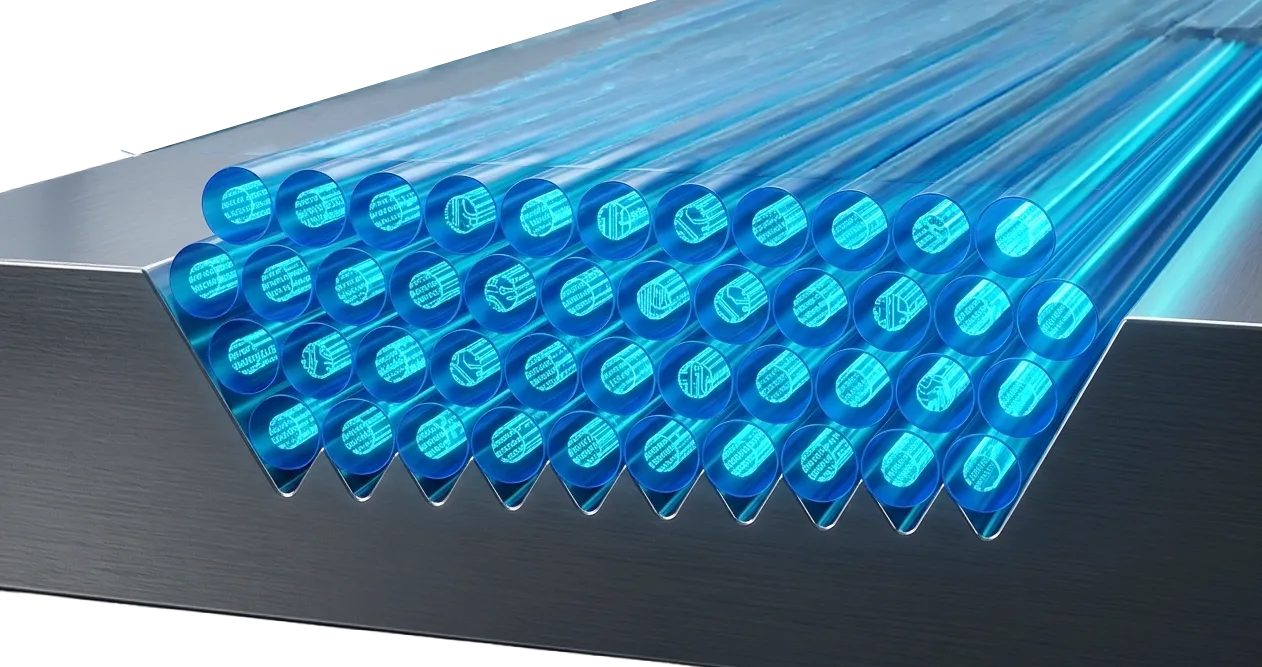
Fiber Array (1D & 2D), an illustration from Largan’s official website. Image credit: Largan Precision Co., Ltd.
Customers Want One Supplier Accountable for Assembly Results
The scope Largan described includes making fiber arrays (FAs), combining them with externally sourced prism microlens arrays (PMLAs) to form fiber array units (FAUs), and then mounting the FAUs on carriers. From a procurement perspective, this brings work that might otherwise be spread across several suppliers and assembly stations into a more complete unit of delivery.
Integration was already under discussion before this investor conference. When discussing the pilot line in June, Lin had linked integrated assembly to clearer responsibility. Largan’s team also said at the time that customers could buy individual components if that was all they needed. Different customers could therefore require different scopes of supply. The October development was that customers were asking Largan to include both FAU assembly and mounting on the carrier.
This arrangement could lower the customer’s cost of coordinating individual component suppliers, while increasing the number of variables the integrator must control. The dimensions and optical properties of purchased components, their positions after assembly, and the test conditions all affect the final result. As Largan’s scope of supply expands, the basis of competition broadens with it: alongside component precision, it must define acceptance criteria, identify the causes of defects, and consistently deliver products that pass inspection.
Precision Has to Survive Assembly
Co-packaged optics (CPO) moves optical engines closer to switching or computing chips, shortening the distance that high-speed electrical signals must travel. The connection between optical fibers and photonic integrated circuits (PICs) thus becomes a part of the package that requires precise handling.
An FAU’s basic function is to hold multiple fibers in place and align them with optical components. V-grooves help define fiber positions, while microlenses and other elements shape the light according to the design. Component tolerances and assembly errors jointly affect coupling performance. Even when each part falls within its permitted tolerance, the assembled combination may still deviate from the position the system requires.
Lin has described Largan’s approach as using equipment developed in-house, together with alignment and assembly processes, to compensate for errors in standard-specification components. This gives the manufacturing capabilities built up in smartphone lenses a new application: value lies not only in selecting the most precise parts, but also in controlling how they are combined. Optical communications products, however, must preserve the performance of the entire optical path. Process control therefore has to expand with the scope of assembly and testing.
Detachable Designs Bring Maintenance into the Optical Interface
Lin said that detachable FAUs are among Largan’s current development priorities. These designs allow fiber connections to be disconnected and reassembled, providing flexibility during assembly, testing, and subsequent maintenance. In return, the interface must return to a sufficiently accurate position every time it is reconnected.
Serviceability and alignment precision must therefore be designed together. If a connection is easy to detach but its optical loss varies after reconnection, maintenance brings adjustment and testing costs back into the process. The integrator’s task extends from making the initial assembly work to maintaining the same acceptance criteria after replacement or reassembly.
Other suppliers are addressing the same requirement in their product plans. In September 2025, GlobalFoundries and Corning announced a collaboration to develop detachable fiber connections. Their GlassBridge approach uses glass waveguides and edge coupling; the companies also said they were developing a detachable solution using vertical coupling. Corning currently positions GlassBridge as a complement to FAU-based approaches, emphasizing passive alignment, detachability, and ease of rework.
Edge coupling brings light into a chip from its side, while vertical coupling brings it in through the surface. FAUs can be designed for either architecture. For suppliers, the choice changes the optical components, alignment methods, and packaging interfaces, as well as how testing and maintenance are organized. Lin said Largan is also working with customers on edge-coupling solutions, although the timetable remains undetermined. After mastering a precision process, a supplier still has to adapt what it delivers to the customer’s platform.
After Qualification, the Test Shifts to Volume Production
According to Lin’s remarks at the October investor conference, Largan’s FA had passed one customer’s qualification for volume production, and its pilot production line had been completed. The planned ramp-up remained targeted for mid-2027. As the product scope expands to include FAUs and carrier assembly, more process steps and acceptance checks must be managed.
In volume production, the key is to reproduce the performance of a small number of samples across different component batches and a continuously operating line. If purchased components vary, will optical performance remain stable after assembly? When rework is needed, can the problem be located and performance restored? Will substantial adjustment still be required after delivery to the customer? Each of these questions affects the cost of integration.
By taking on more assembly work, Largan gives customers an opportunity to shorten the chain of investigation when yield problems arise, while assuming broader responsibility for the results. Its CPO business must now demonstrate whether the additional integration and testing capabilities can reduce rework at the customer’s end while supporting Largan’s own yields and delivery costs.
Sources
- Zhou Jiarong, “Focus: Largan’s Investor Conference Reveals Diverging Prospects for Smartphones and Optical Communications,” Xian Tan Investment Weekly, issue 2426.
- Lin Yuanqing, “Overtaking with an ‘Imperfect Process’: Largan’s Precision Alignment Targets the CPO Opportunity,” Wealth Magazine, issue 766.
- Fan Wenzheng, “Cover Story: A Sense of Urgency Drives Largan into CPO,” Business Today, issue 1543.
- GlobalFoundries, GlobalFoundries and Corning Collaborate To Deliver Detachable Fiber Connector Solutions to Scale Next-Generation Optical Connectivity, September 29, 2025.
- Corning, GlassBridge™ Fiber-to-PIC Connector Technology.