
The race to build AI servers is bringing manufacturing capabilities once tucked away inside cars into data centers. As coolant flows through piping past chips, the precision, cleanliness, and sealing quality of metal components become part of what keeps the entire system running reliably.
Taiwan’s Global Tek Fabrication Co., Ltd. is one example. The manufacturer started with precision metal parts for automotive airbags and has gradually expanded into liquid-cooling quick disconnects, cold plates, and valve bodies. Business Today reports that Global Tek secured a Furukawa Group project for cooling tensor processing unit (TPU) servers and began shipments in mid-2026.
For international technology industry readers, the story is worth following because it shows how an automotive parts maker can apply existing manufacturing capabilities to AI infrastructure, and what new challenges it faces once it enters the market.
There Is Room for Automotive Parts Makers Inside AI Racks
To understand Global Tek’s opportunity, it helps to look at the components of a liquid-cooling system.
A cold plate sits close to the chip that needs cooling, allowing coolant flowing through its internal channels to carry heat away. Quick disconnects link piping and equipment, making the system easier to connect and disconnect while maintaining a seal. A coolant distribution unit (CDU) manages flow, pressure, and heat exchange within the circulation system. These components work together to move heat away from the chips.
For a precision manufacturer, the opportunity lies in the materials, shapes, and manufacturing requirements of these parts. At a seemingly minor connection, a problem with dimensional fit or sealing can expose the system to leaks. A component’s value therefore needs to be considered alongside the responsibility it carries within the system.
Global Tek’s entry point is the metal components and coordination across manufacturing processes that liquid-cooling products require. Furukawa Electric’s March 2026 announcement of plans to expand capacity for data-center water-cooling modules also shows that these products are becoming a business in which major industrial groups continue to invest. As system and module suppliers expand their product portfolios, a component supplier’s ability to turn design requirements into deliverable products takes on practical commercial importance.
What Airbags Teach About Manufacturing Details
Airbags and data-center cooling systems serve very different purposes, but both require careful attention to cleanliness and sealing during manufacturing.
Global Tek’s early products included precision metal parts for airbag gas generators. These products need to work reliably during a vehicle collision, with demanding requirements for internal cleanliness and protection against moisture from outside. The experience Global Tek accumulated across forming, machining, and welding taught it how to connect multiple production steps to meet a product’s quality requirements.
The new work in liquid cooling still revolves around materials, structures, machining, and sealing. Automotive experience provides a starting point for engineering judgment, but the operating conditions, customer specifications, and validation requirements of liquid-cooling components still need to be addressed individually. The ability to make a qualified automotive part does not, by itself, establish whether a different product will remain reliable over long-term use.
Global Tek also had a learning curve in liquid cooling. In 2022, President Yah-Hsing Huang accepted an invitation from a Taiwanese cooling company to help develop quick disconnects and related machining techniques. That collaboration did not reach large-scale production, but it gave the team liquid-cooling development experience. The company later took on cold-plate and heat-sink machining for other customers.
This progression shows how capabilities that span industries are often built gradually through actual projects. Existing technology gives a company a chance to tackle a problem, while new customer requirements push the team to fill gaps in its experience.
Furukawa Needed Multiple Processes Connected Into a Solution
According to Business Today, Furukawa approached more than ten suppliers to develop a cooling system integrating cold plates, quick disconnects, and valve bodies, but could not find a suitable partner because the required manufacturing processes were too complex. Global Tek offered a combination of stamping, forging, and machining capabilities, with work divided among different plants.
Huang summed up the challenge in one sentence: “The real challenge in liquid cooling is not machining, but the solution.”
Once a customer provides specifications, the manufacturing team must assess material properties, component geometry, and function before choosing suitable forming and subsequent machining processes. Huang gave the example of casting a more complex housing at the Xi’an plant before carrying out further machining. Such choices affect a product’s cost, lead time, and consistency in volume production.
Global Tek also brings value analysis and value engineering (VA/VE) into the design stage. For the supplier, this extends its role from carrying out machining to helping select the manufacturing approach earlier in development. For the customer, it creates an opportunity to resolve conflicts between design requirements and production conditions sooner.
At its April 2026 investor presentation, the company listed products including universal quick disconnects (UQDs), multi quick disconnects (MQDs), valve bodies, and cold plates, along with the division of manufacturing processes among its plants. These disclosures outline Global Tek’s liquid-cooling plans and help explain how its capabilities are distributed across multiple components and production steps.
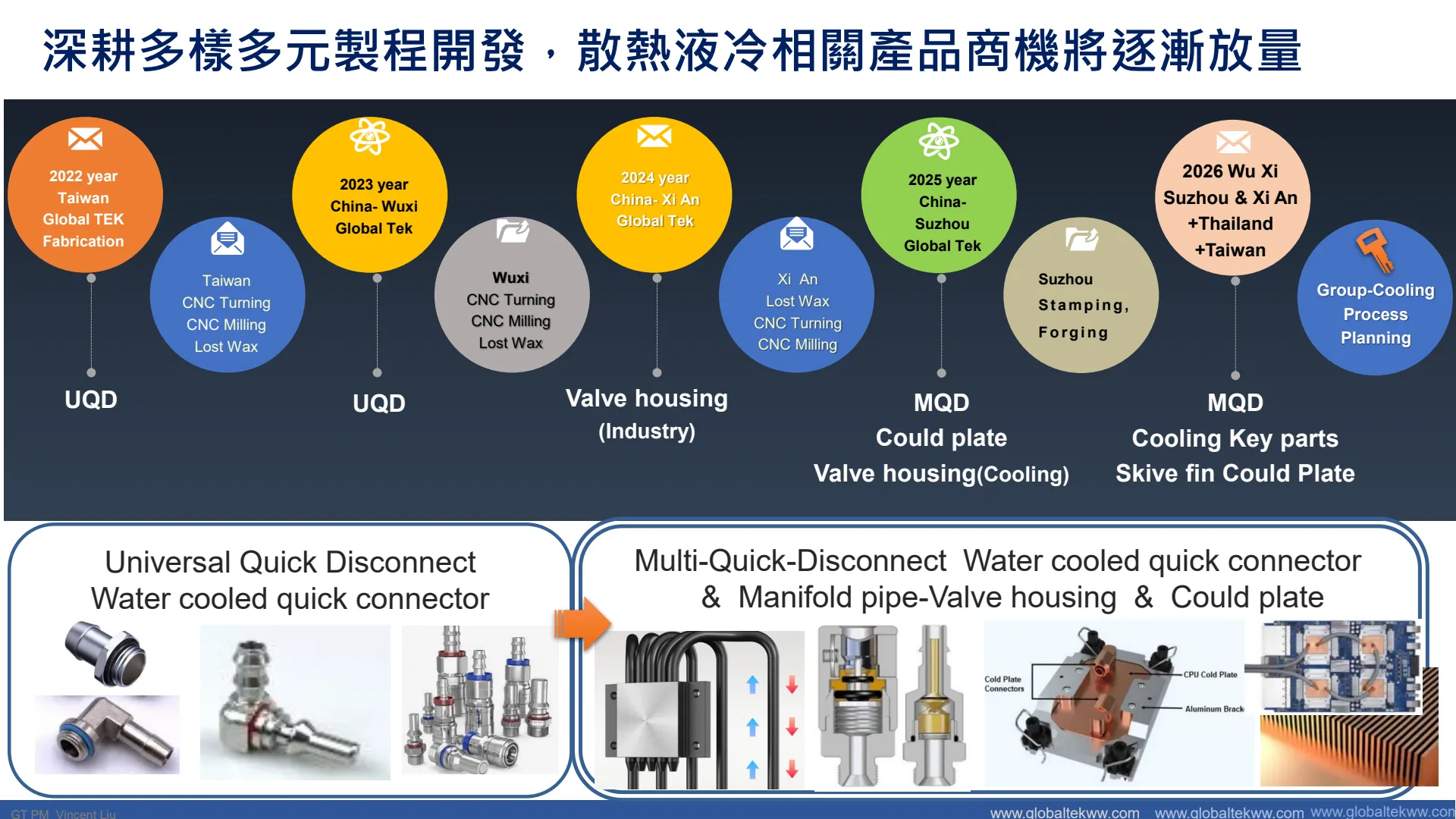
Global Tek’s plans for liquid-cooling components and manufacturing processes across multiple plants, including quick disconnects, valve bodies, and cold plates. The years shown follow the company’s presentation. Source: Global Tek Fabrication Co., Ltd., investor presentation, April 10, 2026, page 24.
A Sample in Three Days: Manufacturing Has to Match a New Pace
Capabilities across multiple processes address part of the question of how to make a product. Delivery speed raises another question.
Chen Guanfu, an assistant manager at Global Tek who leads the Furukawa project, said automotive projects typically start with complete drawings, go through repeated validation, and then enter volume production. A liquid-cooling customer, however, might submit a request today and expect a sample three days later. When there is not enough time to confirm every detail, engineers have to make initial judgments based on experience.
This puts pressure on the early stages of development. Teams must quickly determine which requirements are settled, which can be tested with samples, and which still need clarification with the customer. Fast sample delivery and reliable volume production are two successive tasks. Even after a customer receives a sample quickly, the product still needs to complete the applicable validation to support consistent shipments.
United Alloy-Tech, another Taiwanese company moving from automotive components into liquid cooling, has described a similar difference in pace. Chair Hu Baisha said automotive production follows long-term plans, while server projects demand rapid delivery and flexible adjustments to production lines. Xiong Dong, who leads the company’s liquid-cooling R&D, said the company put at least 18 people on the project to deliver an immersion liquid-cooling rack sample within a month.
United Alloy-Tech and Global Tek make different products, but their experiences point to the same organizational requirement: entering a new market also calls for changes in development decisions, coordination among plants, and production-line scheduling. Existing machining equipment provides a foundation. Making that equipment work together at the delivery pace customers need depends on the team’s execution.
Once You Have a Way In, How Do You Stay?
Technical barriers create opportunities for precision manufacturers, but commercial relationships within the supply chain continue to change.
A liquid-cooling industry participant interviewed by Business Today cautioned that machining suppliers could still face pricing pressure as competition intensifies. An executive at another company that moved from automotive components into cooling pointed out that a supplier could lose business if a customer acquired a precision manufacturer.
System customers’ ability to manufacture components themselves is another relationship to watch. At a 2024 investor conference, Foxconn Chairman Young Liu said the company could manufacture everything from CDUs, quick disconnects, manifolds, and cold plates to racks. Such capabilities mean an integrator can both purchase components and supply them. A machining company’s competition may come from peers or from its own customers.
My reading is that Global Tek’s commercial advantage will depend on how much of a rushed first project can be reused. Established tooling, process sequences, and inspection criteria can make later orders less demanding on engineering time. Constant redesign would make growth more expensive, even with strong demand.
Repeat orders, delivery performance, and the profitability of the cooling business would help distinguish those outcomes. Group-level margins alone cannot isolate the contribution from liquid cooling. Customer self-production and acquisitions remain risks even if the manufacturing work is technically successful.
Sources
- 曹悅華, “企業最前線:時碩靠金屬加工硬實力 拿日系液冷大單” (Global Tek Wins a Major Japanese Liquid-Cooling Order With Its Metalworking Capabilities), Business Today (今周刊), issue 1554.
- 羅之盈, “封面故事:精確實業靠防漏技術 搶AI液冷商機” (United Alloy-Tech Pursues AI Liquid-Cooling Opportunities With Leak-Prevention Technology), Business Today (今周刊), issue 1550.
- 楊孟軒, “輝達GB200揭開散熱新時代!液冷價格躍升15倍,7家台廠已搶進供應鏈” (Nvidia’s GB200 Opens a New Era in Cooling: Liquid-Cooling Prices Rise Fifteenfold as Seven Taiwanese Companies Enter the Supply Chain), CommonWealth Magazine (天下雜誌), issue 812, November 26, 2024.
- Global Tek Fabrication Co., Ltd., Investor Presentation, April 10, 2026, pages 6 and 24.
- Furukawa Electric, Notice Regarding Capital Expenditure (Acquisition of Fixed Assets) for Production of Heat-Dissipation/Cooling Products for Data Centers, March 30, 2026.
Updated Oct 16, 2026