
This article is adapted from a Sidechat podcast interview with Li I-Ru, CEO of Dragonfly UAS (翔隆航太).
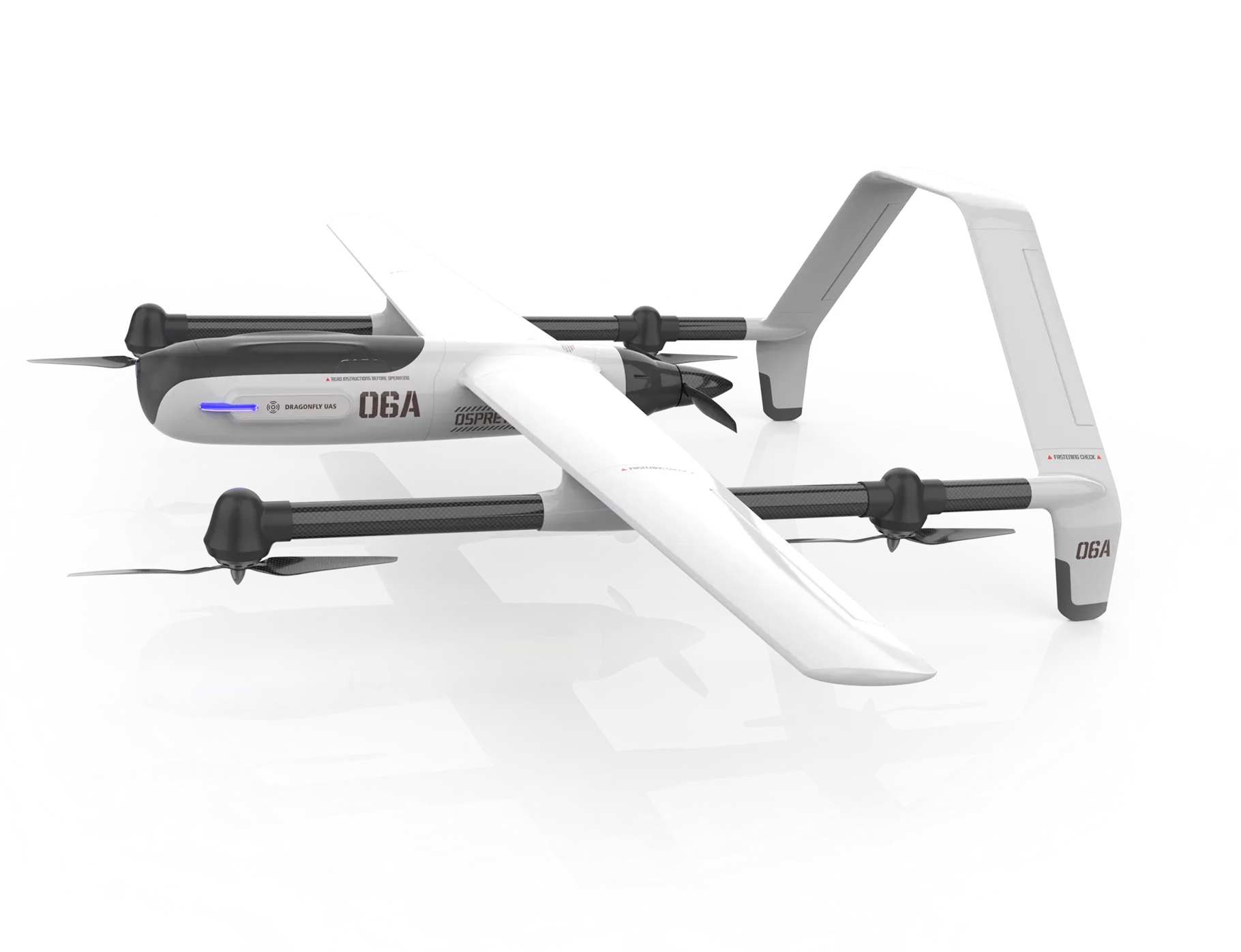
Osprey product rendering from Dragonfly UAS’s official website, accessed October 16, 2026. It illustrates the company’s fixed-wing VTOL range; it is not a contemporaneous photograph of the prototype described in the 2025 interview. Image: Dragonfly UAS.
A Decade Focused on the Sky
Dragonfly UAS has spent the last ten years dedicated to a single domain: the sky. The company focuses exclusively on the unmanned aerial vehicle (UAV) industry, deliberately avoiding ground or maritime vehicles.
In recent years, spurred by global events like the war in Ukraine, military and tech expos have been flooded with drones. To the average person, however, they all look remarkably similar, making it nearly impossible to judge their quality or capabilities.
The differentiation in drones is much like that in automobiles. Four wheels get you down the road, but there’s a world of difference between a standard sedan and a multi-million-dollar supercar. Drones may share the same visible components — lenses, batteries, motors, and propellers — but their price tags can differ by an order of magnitude.
The critical distinction lies hidden inside. The core of a drone’s value is its internal component design, its flight controller, and most importantly, its algorithms.
Open-Source vs. Proprietary: Why Software-Hardware Integration is King
Sharing an open-source flight-control framework does not make two aircraft equivalent. Product performance also depends on the sensors, control implementation, safety features, and validation around it. This comparison does not require an assumption about the software architecture of a particular Skydio model.
The key differentiator isn’t the framework; it’s how a company defines its product, the rigor of its reliability testing, its performance optimization, and its investment in proprietary algorithms (like obstacle avoidance and autonomy).
Deep integration of software and hardware is central to this distinction. Reliability targets differ between reusable inspection platforms and expendable aircraft. Those are design and mission tradeoffs, not evidence that a named platform has demonstrated one failure per million flight hours or that a particular loss rate is universally acceptable.
The Skydio Alliance: From Rejection to a Silicon Valley Lifeline
Dragonfly UAS has been a key distributor for Skydio in Taiwan for several years. Skydio, an American manufacturer that has publicly stated it is “proud to be sanctioned by China,” wasn’t always a partner.
“We first approached Skydio’s Japanese subsidiary five or six years ago,” Li explains, “but at the time, they had zero interest in the Taiwanese market, focusing instead on North America and Japan.”
That calculus changed about two or three years ago. “The international atmosphere shifted,” Li says. “There was a strong sentiment in Silicon Valley of ‘we need to help Taiwan.’ Skydio shared this view, and we began serious discussions on how to deploy their products in Taiwan for military, infrastructure inspection, and public safety applications.”
The Pilot Shortage and the Case for Automation
Li identifies a shortage of qualified pilots as an important constraint on Taiwan’s drone deployment. Agricultural and military applications both require trained operators, and expanding fleets increases that staffing challenge.
“As demand explodes, the human resource gap is impossible to fill manually,” Li notes. “This is why the next phase for drones must be automation and AI.”
Skydio’s Remote Ops approach allows an operator to control an aircraft from a different location using a network connection. Distance between the operator and the operating site should not be confused with the aircraft’s flight range. Remote operations can help address staffing constraints, subject to connectivity, operational safeguards, and applicable authorizations.
DaaS: When the Client Just Wants the Data
Recognizing that many clients only have sporadic needs — perhaps 20 flights a year — Dragonfly launched its DaaS (Drone as a Service) offering. Through DaaS, a client can simply order a mission without having to recruit pilots, purchase hardware, budget for maintenance, or conduct daily training.
“The core of the service is understanding what the client truly needs,” Li says. “They aren’t interested in the joy of flying; they have an urgent problem and they need data.”
Dragonfly’s role is to bridge this gap. The company captures the required imagery at a specific time and place, then processes it into the format the client needs — be it inspection video, a 3D model, or a point cloud for further analysis.
The “Mobile IoT”: Practical Applications from Slopes to Skies
In Dragonfly’s experience, these client needs are highly practical. One of the most common applications in recent years is assisting highway agencies with slope inspections to prevent landslides. Previously, this relied on human inspectors, which was dangerous and left significant blind spots. Today, drones are a time-tested tool for these agencies.
Other applications include monitoring factories, rail lines, bridges, and long-term surveillance of specific development areas. The drone, Li says, acts as a “mobile IoT device,” capable of covering the blind spots that fixed sensors can’t reach.
The “Drone That Comes Home” is Already Here
The science-fiction vision of a drone that automatically patrols, reports its findings, and returns to a charging station is no longer science fiction.
Skydio’s “Dock” system is essentially an outdoor charging station for drones — a “Roomba charger for the sky” — that protects the aircraft from rain and recharges it between missions.
The FAA’s BEYOND program documents specific operational waivers involving Skydio aircraft. For example, in January 2024, Kansas partners received a waiver for Skydio X2E remote-dock operations for construction monitoring and campus security in Salina. Such permission applies to the approved operation and its conditions; it is not blanket certification of every Dock deployment. In a public-safety setting, a remotely deployed drone can help responders assess a scene before personnel arrive.
Dragonfly’s Own Hardware: Building Taiwan’s All-Weather Drone
Beyond distributing Skydio’s technology, Dragonfly UAS is developing its own hardware. The company showcased a self-developed hybrid drone that, at 3.2 meters long and 25 kilograms, is far larger than the X10 and serves a completely different purpose.
It combines the benefits of a multi-rotor (for vertical take-off and landing, or VTOL) with the long-endurance advantages of a fixed-wing aircraft.
The goal is to fill a specific, critical gap in the Taiwanese market: the need for a drone that can withstand the island’s harsh, weather-prone environment and stay airborne for two to three hours or more.
The Real Challenge: “De-Sinicization” vs. Integration
In developing a domestic drone, is “de-Sinicization” — the process of building a supply chain free of Chinese-made components — the biggest hurdle?
According to Li, the primary difficulty is actually airframe integration.
“Taiwan is relatively weak in the aerospace industry,” he states. “We lack experience in vehicle integration, and talent often flows elsewhere.”
Taiwan’s advantage, however, lies in its powerful foundation in manufacturing, ICT, software, semiconductors, and optics — a “dividend” left over from the PC and laptop eras.
“Taiwan is perfectly positioned to invest in unmanned vehicles right now,” Li argues. “In contrast, other major aerospace nations might see it as an opportunity-cost problem, preferring to fight for dominance in semiconductors rather than this emerging industry.”
“Avoiding red components or navigating the domestic supply chain are just processes,” he continues. “Once you cross that bridge, it’s no longer a long-term problem. The real, persistent challenge is that Taiwan’s aerospace talent development, industrial implementation, and path to the international market are still fragmented.”
A Nascent Market Driven by Necessity
Dragonfly assesses the current drone market as being in its “nascent stage,” not yet seeing the explosive, exponential growth of AI. But the trajectory is clear.
“We can pragmatically deduce that the market will continue to develop at a high speed,” Li says.
The primary drivers are societal. Human labor is becoming scarcer and more expensive, yet the areas we need to manage — whether for disasters or assets — are only getting larger. Fixed IoT sensors have limitations. They must be complemented by mobile vehicles. In a large area where a rapid response is needed, an aerial vehicle can complement fixed sensors and ground-based teams.
Taiwan’s True Test: Weather, Wind, and Aerospace Culture
While Ukraine has provided a validation ground for drone warfare, its continental plains are environmentally distinct from Taiwan’s maritime setting.
“Taiwan’s challenge is the wind,” Li emphasizes. “Our climate conditions, from the seasonal northeast monsoon to dense fog, are far more severe than in continental Europe.”
An adversary, he notes, will not wait for a clear, sunny day. They will exploit gray-zone conditions. Li’s argument is for aircraft designed around Taiwan’s demanding weather. That goal does not mean any drone can operate safely in every condition; each design still has a validated operating envelope.
This introduces a critical trade-off. “A manned aircraft stays grounded in bad weather to protect the pilot,” Li says. “An unmanned drone stays grounded to protect the asset. But in an emergency, a commander can make the call to sacrifice the drone to get eyes on a situation, even if it doesn’t come back.”
Why Aerospace Could Be Taiwan’s Next Frontier
Dragonfly initially explored the agricultural sector but ultimately pivoted. The reason? “Agriculture is a market built on local connections and service, not hardware,” Li explains. The sector needs cheap, reliable tools, but its demands aren’t high-spec enough to justify the R&D for advanced vehicles like VTOL.
Ultimately, Taiwan’s drone industry faces a cultural hurdle. The nation’s public imagination for aerospace is relatively weak, a possible legacy of having few national space programs (TASA has only recently gained prominence) and a talent gap that formed after the Indigenous Defense Fighter (IDF) program wound down.
“Taiwanese culture is less inclined to accept the high-risk, high-investment, failure-prone nature of the aerospace industry,” Li concludes.
“The aerospace industry should be viewed as a vector for advancing national technology. Just as the gaming industry drove 3D computing, aerospace reflects a country’s development in heavy industry, systems integration, and high-end products.”
“Properly developing the aerospace industry — both space and aviation — will largely set the foundation for Taiwan’s role on the international stage over the next 30 to 50 years. What Taiwan needs is a cultural shift… to light that final fire, build its own drones, and fly on its own technology.”
Updated Oct 16, 2026