
Manufacturing challenges in AI hardware can bring two seemingly distant industries together. One is racing to expand chip packaging capacity; the other has precision manufacturing resources built for the automotive industry that remain underused. Taiwanese equipment maker Eternal Precision Mechanics is trying to connect these different demand cycles.
General manager Kazutoshi Iwata says the company’s order book extends into 2029. With its existing capacity, delivery of new orders could stretch into 2030. The company’s response is to seek additional assembly capacity in Japan’s automotive supply chain. The reported partner is an unnamed subsidiary of a Toyota Group member company; this is an equipment-assembly arrangement, not evidence of Toyota Motor ordering AI chips or packaging equipment.
Precision Manufacturing Resources in the Toyota Group Supply Chain
Jian-he Lu (呂建和), a manager in Eternal Precision Mechanics’ general manager’s office, describes the partner as a wholly owned subsidiary of a Toyota Group member company. Headquartered in Toyota City, Aichi Prefecture, it designs and develops molds for automotive components and manufactures production equipment. According to Lu, the factory previously produced components for fuel cell vehicles and handled precision assembly. Slower-than-expected market adoption left capacity available for the collaboration.
Iwata says the contract manufacturing partnership began in June 2026. After roughly two months of staff training, assembly started in mid-August, with the first equipment shipments expected in October. He says the actual increase in capacity can be assessed more accurately once the operation has been running for some time.
How Does AI Demand Create an Equipment Assembly Bottleneck?
Eternal Precision Mechanics supplies vacuum lamination equipment, with technology and manufacturing capabilities that include its Japanese subsidiary, Nikko-Materials. A key market is integrated circuit (IC) substrates: advanced chips use the wiring in these substrates to connect signals and power to external circuit boards.
Ajinomoto Build-up Film (ABF) is an insulating film developed by Ajinomoto. When substrate manufacturers build multilayer wiring, they must bond this material evenly to the surface. Lamination equipment performs that bonding step. Materials suppliers, equipment makers, and substrate manufacturers each contribute distinct capabilities.
As AI chip packages grow larger and their wiring becomes more complex, substrate manufacturing must handle larger areas, more build-up layers, and stricter quality requirements. For Eternal Precision Mechanics, demand therefore comes from both customers’ capacity expansion and process upgrades. New factories can be planned and equipment orders placed, but equipment makers still have to assemble, test, and deliver each machine.
When several substrate manufacturers expand at the same time, their equipment suppliers’ assembly capacity can constrain the expansion schedule. This helps explain Eternal Precision Mechanics’ interest in the automotive supply chain. It needs manufacturing capacity it can draw on, and Japan’s established precision machinery clusters offer an option alongside building its own assembly lines.
Transferring Precision Manufacturing Capabilities Requires Mastering New Quality Requirements
Assigning people and factory space to new orders addresses only part of the task of reallocating capacity across industries. Eternal Precision Mechanics’ equipment must also enable customers to maintain consistent quality through repeated lamination cycles.
Vacuum lamination bonds film to surfaces with fine wiring and variations in height, reducing bubbles, wrinkles, and uneven thickness. The company’s product range includes three-stage systems that address advanced substrates’ requirements for flatness and process stability. These requirements carry the importance of machine assembly quality through to customers’ finished products.
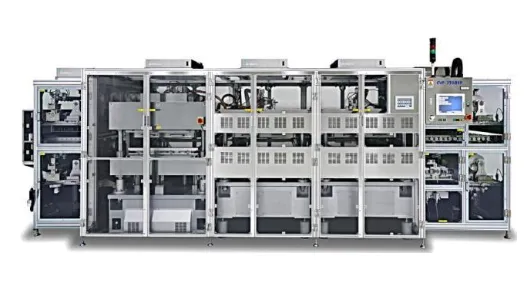
Eternal Precision Mechanics’ CVP-1700SP three-stage vacuum laminator. Image: Eternal Precision Mechanics.
Iwata illustrates the cumulative effect with an example. If the pass rate for each lamination cycle stays at 98.5%, about 86% will pass after ten cycles. At 95% per cycle, only about 60% will pass after ten cycles. This illustrative calculation assumes a constant pass rate at each cycle and no rework, showing how repeated processing magnifies the difference.
Customers also care about reproducible process conditions. Discussing Kinsus’ K6 factory in Youshi, CEO Scott Chen says equipment must reach the required temperature, pressure, and other parameters before processing substrate panels. Kinsus also uses data to establish more consistent defect criteria with packaging companies.
Iwata notes that switching from a qualified equipment supplier requires customers to repeat qualification and accept the risk of fluctuations in production yield. As Eternal Precision Mechanics expands assembly capacity, it therefore needs to reproduce the equipment quality customers already know and can use consistently.
Targets for Expanding Assembly Capacity in Japan
The company’s August 2026 investor presentation outlines how Nikko-Materials is responding to demand through short-term factory leases and contract assembly personnel in Japan, along with cooperation with an automotive supply chain company. The plan is to raise maximum monthly assembly capacity in Japan from 18 machines to 28, increasing it quarter by quarter, with a target of mid-2027.
More Assembly Space Must Become Accepted Machines
The planned increase from 18 to 28 machines a month measures assembly capacity, not completed deliveries or revenue. Additional space and workers become useful only when machines finish testing, meet customer acceptance requirements, and ship on schedule.
My reading is that this partnership should be judged first by delivery time and acceptance performance. If an extra assembly site shortens the queue without adding rework, it addresses EPM’s immediate constraint. If testing and correction simply move downstream, the larger capacity figure will overstate the improvement. That is the practical significance of borrowing manufacturing capacity from the automotive supply chain.
Sources
- Lin Yuanqing, “Eternal Precision Mechanics Taps AI Growth and Positions Itself for Advanced Packaging,” Wealth Magazine, no. 774, October 8, 2026.
- Deng Kaiyuan, “Kinsus Raises PCB Yield Above 90%: What Changed in Its NT$25 Billion AI Production Line Investment?”, CommonWealth Magazine, no. 832. Article.
- Eternal Precision Mechanics, Product Introduction, vacuum lamination equipment and model series.
- Eternal Precision Mechanics, Investor Presentation, August 26, 2026, p. 18.
Updated Oct 16, 2026